Showing posts with label God's Triangle. Show all posts

Thursday, 28 December 2017

An unplanned and relaxed writing life

Some writers plan their lives; some don’t. I’m one of those folk who have planned almost nothing about their lives. I can’t make up my mind whether this is from laziness or a lack of commitment or a deep-seated fear of failing to achieve a lifetime of targets. It’s probably chiefly the last of these three, if I’m honest.
      I have known ambitious people who have led miserable lives never achieving things that they regard as their due. Not me. I can’t be bothered. But having stated that, it is a serious mistake for a writer not to make the best of the opportunities that come their way.


      Although I have always loved writing, it was never my expectation that I would become someone who earned a living from it. As a teenager in the small Australian town of Charlton, Victoria, I worked after school for the local jeweller and watchmaker and it had been agreed that when I had completed my schooling I would begin a formal apprenticeship as a watch repairer.
      But it wasn’t to be. My father, who owned a small printing business and edited the local weekly newspaper, the Charlton Tribune, had other ideas. Unbeknown to me, he was losing a struggle against cancer and he needed me to help out in the business. So began an apprenticeship as a printer, learning skills that have proved useful to this very day.
      After my father’s death, my mother took over the business, and as she was not a journalist, I found myself with the opportunity to contribute a growing of articles to the newspaper, affectionately referred to as “the local rag”. A few years later my mother remarried and sold the business, and I moved on to broadcasting journalism with 3BO Bendigo and 3AW Melbourne, then moved to London and the BBC World Service.
      None of this had been planned. It just sort of happened. But I am hugely grateful for the skills I acquired along my haphazard route -- particularly in radio and television news which taught me there can be no such thing as writer’s block in that medium. The quickest way to be fired in broadcasting is to tell an editor “I can’t think what to write”.
      After I retired from the BBC, I did the usual lecturing and consulting stuff, but still without any plan to write books. Instead, when I stumbled across a scandal in my own family, I thought of it more as a film than a book. It was a chance suggestion by my wife that prompted me to match the screenplay, God's Triangle, with a book. Then a discussion with a journalist mate led to another screenplay and another book – this time about the moral challenges facing foreign correspondents and title The Mortal Maze. I've now written a novel version of the first book: Florrie - A Life Unexpected.
      I have a few other possible books that I might produce, if I don’t get too distracted by writing for blogs and contributing too many postings on Facebook and Twitter, but if they don’t happen, too bad.
      If this all seems a bit flip, it isn’t intended to be. My message is that if you want to plan your life and career, go ahead. But don’t get upset if it doesn’t quite work out the way you hope. Instead, I suggest you let life roll on while grasping those opportunities that do come your way and make the very best of them.
      That’s my plan for a happy, disappointment-free writing life.

First published as a guest posting on the Alliance of Independent Authors Blog

Saturday, 5 August 2017

Thank you, Blonde Lawyer

As any author will tell you, writing a book is a long and often-tedious task. Then there's the problem if getting it published and circulating it in the great wide world in competition with hundreds of thousands of other books. Therefore, I am pathetically grateful whenever I get a four or five star reviews.  Here's one from someone who appears to write from the heart:

Thank you, Blonde Lawyer, whoever you are, wherever you are, for this Amazon review of my true story of scandal and cover-up called God's Triangle


And here is one of the other very nice reviews:

And now if you want to read some of the other God's Triangle reviews and comments, go here


Tuesday, 17 January 2017

How a missionary scandal in Australia and India was covered-up

About God's Triangle by the author, Ian D. Richardson 

This is the true story of Florence M. Cox. "Florrie", as she was widely known, was my great aunt. She died in Melbourne, Australia, in 1950, understanding little of the circumstances that destroyed her marriage and her life as a Baptist missionary in East Bengal (now Bangladesh). It is also an account of an establishment cover-up of the scandal surrounding her failed marriage, and of how her husband, the Rev. Frank E. Paice, and his mistress and second wife, A. Olga Johnston, erased a whole chunk of their past to become pillars of society in Australia.

      The story reveals much about the social constraints of an age when strict Christian virtues and rigid social taboos reigned supreme over intelligent open discussion and a realisation that life's problems must not be viewed simply as black or white, or Christian good versus evil.
      God's Triangle is about my search for the truth surrounding my great aunt. The story would have remained a secret, had it not been for my mother casually showing me a photograph that excited my incurable journalistic curiosity.
      I was brought up in a staunchly-Protestant environment, but I am no longer a believer, nor have I been since my late teenage years. Hence, this story is viewed through the prism of an atheist, but I hope believers will accept that I have done my best to tell the story with honesty and fairness.
      My great aunt and her fellow Christian missionaries in India were mostly kind souls who genuinely believed that they had a God-given mission to link "doing good" with spreading the word of the Lord and obtaining conversions, heedless of the cost to themselves or the converts.
      As part of the cover-up some years later, most of the related official documents were lost or destroyed by the Baptist Church. All that remains in the church records are a few cryptic minutes from board meetings of the Baptist Foreign Mission Board in 1918 and 1919.
      The families involved in events that I will recount also destroyed their records, or at least hid them where they hoped they wouldn't be found. Had it not been for old copies of the missionary magazines, The Southern Baptist, Our Indian Field and Our Bond, held in Baptist archives in Melbourne and in Oxford, England, it would have been impossible to get to the truth. The magazines themselves did not refer to any scandal, of course, but they did provide vital dates and other clues that helped my wife and me assemble a jigsaw.
      A jigsaw is a perfect analogy for how our research progressed. Not all the pieces could be found, but we were able over the years to put together a reasonably complete picture. Sometimes, we would go weeks or months without finding a piece of the jigsaw and even when one was located, it wasn't always possible to know where it fitted. However, since the first edition was published, further information has emerged, requiring an additional chapter in this edition.
      It would have been nice to assemble the God's Triangle jigsaw in an orderly manner, say, bottom up or top down, but it was never going to be like that. Sometimes we would find a big chunk of the picture but not fully understand what it portrayed. And sometimes we would fail to spot the obvious, or would be led off on a false trail.
      A vital part of the jigsaw was provided by the divorce file for Great Aunt Florrie and Frank Paice. But as you will learn, the divorce papers were part of the cover-up and far from easy to obtain.
      The depth of the embarrassment and anxiety that erupted around Florrie Cox, Frank Paice and Olga Johnston cannot be overstated. Worst of all, it tore apart the Paice family and spilled over into my own branch of the Cox family, even though Great Aunt Florrie was arguably an entirely innocent party.
       © Copyright Preddon Lee Limited, London W5 5QB, United Kingdom. All Rights Reserved

Friday, 6 January 2017

The cost to history of digital photography


How an old photo led to my writing a book, but how many  family photographs will survive our digital age?

Some years ago, during a visit I made to my mother in Melbourne, Australia, we found a box of old photographs on top of a wardrobe. It was a goldmine of family memories, but not without its problems. The colour prints were mostly faded, and while the black-and-white and sepia photos were generally in good condition, almost none bore any identification.

We spent hours working our way through the photographs, using a soft pencil to write names, and where possible, locations and approximate dates on the back of each one.

As we worked our way through the collection, my eye was caught by a family group photograph taken in a studio in Melbourne in 1914 around the time the First World War was getting underway. The group included a woman I had never seen before.

My mother, who has since died, identified the woman as my Great Aunt Florence “Florrie” Cox, and under my cross-examination, she very reluctantly revealed that Florrie had been a Baptist missionary in East Bengal (now Bangladesh) and had innocently been caught up in a terrible scandal that had shamed the family in Melbourne.

I had originally thought this would be a marginal family history episode, but the more I learned the more I realised that I had a book in the making. This was published as God’s Triangle. Had my mother not had such a clear long-term memory, that old photograph would not have been identified and the fascinating and touching story of God’s Triangle would have remained untold.

There was a time, not that many decades ago, when taking a photograph was an event from which the results were treasured. Families would have a Kodak Box Brownie or maybe, as I did, a clunky East German Praktica 35mm. Most of the photos would be in black-and-white or sepia, although with the growth of 35mm cameras, a treat would be to buy a roll of Kodachrome colour transparency film.

Special events, such as weddings and the birth of a child in the family, would occasion the services of a professional photographer or perhaps a visit to a photographic studio with its massive lights and camera. The photographs from these sessions were archival quality and became proud possessions to be passed on from generation to generation.

The rot began to set in when cheap cameras, 35mm colour print film and one-hour processing began to dominate the market in the 1970s and 1980s. Colour photographs became the norm and began to lose their value as a means of permanently recording our lives pictorially.

Extra prints were sometimes ordered for friends, then the negatives would probably be binned. Worse – and this is something few people realised – these colour prints were prone to discolouring and fading and had little or no long-term archival quality.

It is safe to estimate that billions of digital photographs are now taken around the world each day, the majority of them on smart phones, but how many will survive to take their place in a family’s historical record? Almost none.

Some of these photographic efforts end up being emailed to friends and family, or are posted on Facebook, Twitter, Instagram, Flickr and other social media outlets, but are very rarely turned into prints that can be held in the hand and admired, or put in a frame or even a photographic album.

The irony is that the technical quality of the pictures taken on digital cameras and smart phones is exceptionally high, but not by the time they are transferred to the social media. They may look good on a computer screen, but they can’t be printed in good quality.

From time to time, I get interesting family photographs emailed to me, or they are posted on Facebook, and I ask for high-definition copies so that I can produce good quality prints and add them to my family history archive. I rarely get them, either because they have been deleted, or the photographers can’t figure out how to process them in top quality.

A friend of mine fires off the camera in his iPhone at every opportunity, but when I ask him what happens to all the pictures, the short answer is that they are mostly lost whenever he upgrades his mobile phone or computer, something that he does quite frequently.

This takes me onto another bugbear: identification of photographs. Almost since photography was popularised by the likes of Fox Talbot and George Eastman, there has been a failure to identify the who, the where and the when on a photograph.

It is sometimes a tedious task, but all my saved photographs are identified, usually with a caption added when I process them through my Photoshop, or similar, software. This often prompted ridicule on the part of my family and friends, but I am delighted to report that I am gradually winning them over. 

Initially, when I showed a photo with a name, location and date on it, I would be told “But we know all that!” My answer is “Well, you know that now, but I bet you won’t remember the date in a matter of months. You will be a bit hazy about the location in a few years, and a few years after that you won’t be entirely sure who all the people are. This has proved to be true in many cases.

While I fear for the future of our family photographic history, new and cheap printing opportunities have emerged in recent years as a benefit of digitisation. It is now possible with fairly basic computer skills to design a photobook that can be printed by a commercial company for as little as £10, although £40 is a reasonable expectation for larger books with hard covers.

Photobooks have an advantage over the old photographic albums in that the photos do not become unstuck and fall out over time. So, while I fret that so much of our pictorial history is being lost, never to be recovered, it is not all depressing news.

Wednesday, 16 March 2016

Unwitting revelations about an author

My true story God's Triangle attracted many uplifting and supportive reviews and reader comments. But not everyone was pleased. One woman denounced it as rubbish without having read it. Another, a member of my extended family, hated it because she thought it revealed too much private information about my great aunt Florence "Florrie" Cox. She made it clear that God's Triangle told her more about my character than I had intended.

She was quite entitled to her view and despite her upset, we remain good friends.

Her comments were interesting. I would have said that the book revealed to the reader little more than the impression that I was like a dog with a bone when it came to researching something that caught my interest. But obviously, my family member saw much more than that and didn't like what she saw.

I knew from the moment I began writing my novel The Mortal Maze I would might reveal all sorts of things about my character. I accepted that.

Inevitably, I was asked if I had based the main character, Jackson Dunbar, on myself. I replied with honesty "not in any way". Then a friend and former BBC colleague who had worked for me on a big international story said the bureau chief Mack Galbraith was me. Eh? How could  that be? Mack was Scottish (I'm not), he was a chain smoker (I haven't smoked since I left high school), he drank copious amounts of whisky (I prefer beer), and he was incredibly untidy (well, I'm just a little untidy).

"Yes, I know you're not a smoker and I never suspected you kept bottles of whisky under your coat (or even in your office)," responded my friend, "but these are mere superficialities compared to the similarities between the way you and Mack each acted as a certain kind of non-nonsense hack-cum-office manager in the field, somehow being both protective shield and connecting bridge between highly strung, overwrought correspondents and the corporation stuffed shirts back home."

On reflection, my friend is right. Although I believed I had created a character who was nothing to do with me -- I thought I was basing it on a hard-drinking, chain-smoking, untidy, and entertaining former colleague -- the reality was that I had unwittingly modelled the essentials of his personality on how I ran a team -- or tried to anyway -- when covering a big story.

I can be most grateful that my friend didn't think that the character Dick 'Psycho' Passick was me. Now that would have been very, very upsetting!
A selection of comments/reviews of The Mortal Maze can be seen HERE.

Saturday, 30 January 2016

A Q&A about my books and why I wrote them

My two books, God's Triangle and The Mortal Maze, are now available in epub format for those who prefer this to Kindle or paperbacks. The epub versions can be dowloaded here through Smashwords and will soon be offered by other major distributors and publishers. As part of the sign-up, I have done this Q&A:

After many years in broadcast and print journalism, you have switched to other forms of writing. What are they?
I now mainly write books and screenplays. I have two books published -- God's Triangle, the true story about my investigation into what happened to a missionary great aunt in Bengal (now Bangladesh) and The Mortal Maze, a fictional thriller about the corruption of a television foreign correspondent by the intelligence services. A third book, Seeds of Revenge, another thriller, will be published later this year. I also have four screenplays, one of which is in pre-filming development in Australia.
What attracts you to a story?
First of all I need to be intrigued. With my non-fiction book, God's Triangle, my journalistic instincts told me that there was a story that should be investigated and might provide some enlightenment, if told sensitively. As for The Mortal Maze, I wanted to use fiction to explore moral challenges that inevitably arise for journalists when working in a foreign, often dangerous, environment.
For the full interview, go here.

Saturday, 12 September 2015

Book publishing: typos and other dumb errors

When I published my first book -- a non-fiction story, God's Triangle -- it was edited by one person and beta-read by four other people. As far as I know, it contains no errors. However, my new thriller, The Mortal Maze, has been professionally edited and proofed at some expense by two people, been edited again (free of charge) by a third person and checked for errors by at least six beta readers. Yet when the book proofs came back from the printers earlier this week we still found a significant number of typos. How come? What's so different with this book? Is it because several of the readers told me they got completely carried away by the story, thus failing to note errors? Or could there be some other reason? 

One interesting suggestion is that proof readers be required the read a book twice -- once front to back, then from back to front. That way, it is said, few errors will be missed.

Anyway, The Mortal Maze is now available error free (I hope).

Saturday, 16 May 2015

Self publishing versus vanity publishing

I have now finished the draft of a thriller, yet to be finally named. Like my previous non-fiction book, God's Triangle, it will be self published, or indie published, if you prefer. There was a time not long ago when any self published book was considered a vanity project. Often it was a vanity project, of course, but sometimes it was just a book that was intended for limited distribution.

Things has changed dramatically in recent years. If some established and reputable publisher were to make me an attractive offer, I would consider it. Meantime, my book will already be out in the wide world and on sale, rather than sitting in some publisher's in-tray for months on end. Also, the marketing and everything else about the book will remain totally under my control.

The growth of self-publishing has, inevitably, resulted in a lot of unreadable rubbish being inflicted on the market -- mostly because of authors who arrogantly believe their work to be beyond improvement. Consequently, they publish it without seeking the opinion of potential readers (known as beta readers), let alone allowing their words to be professionally proofed and edited. But that is rapidly changing, not least because of the encouragement and growing power of independent publishing groups such as the Independent Alliance of Authors. This organisation encourages its authors to produce writing of the highest quality by getting their books properly proofed and edited. Some poor books will still slip through the net, but let's face it, there is a lot of literary trash out there that has gone through the traditional vetting and publishing route.

For more on the subject of self-publishing, go to this London Guardian article.

Wednesday, 18 February 2015

A mystery solved, but only after a long investigation

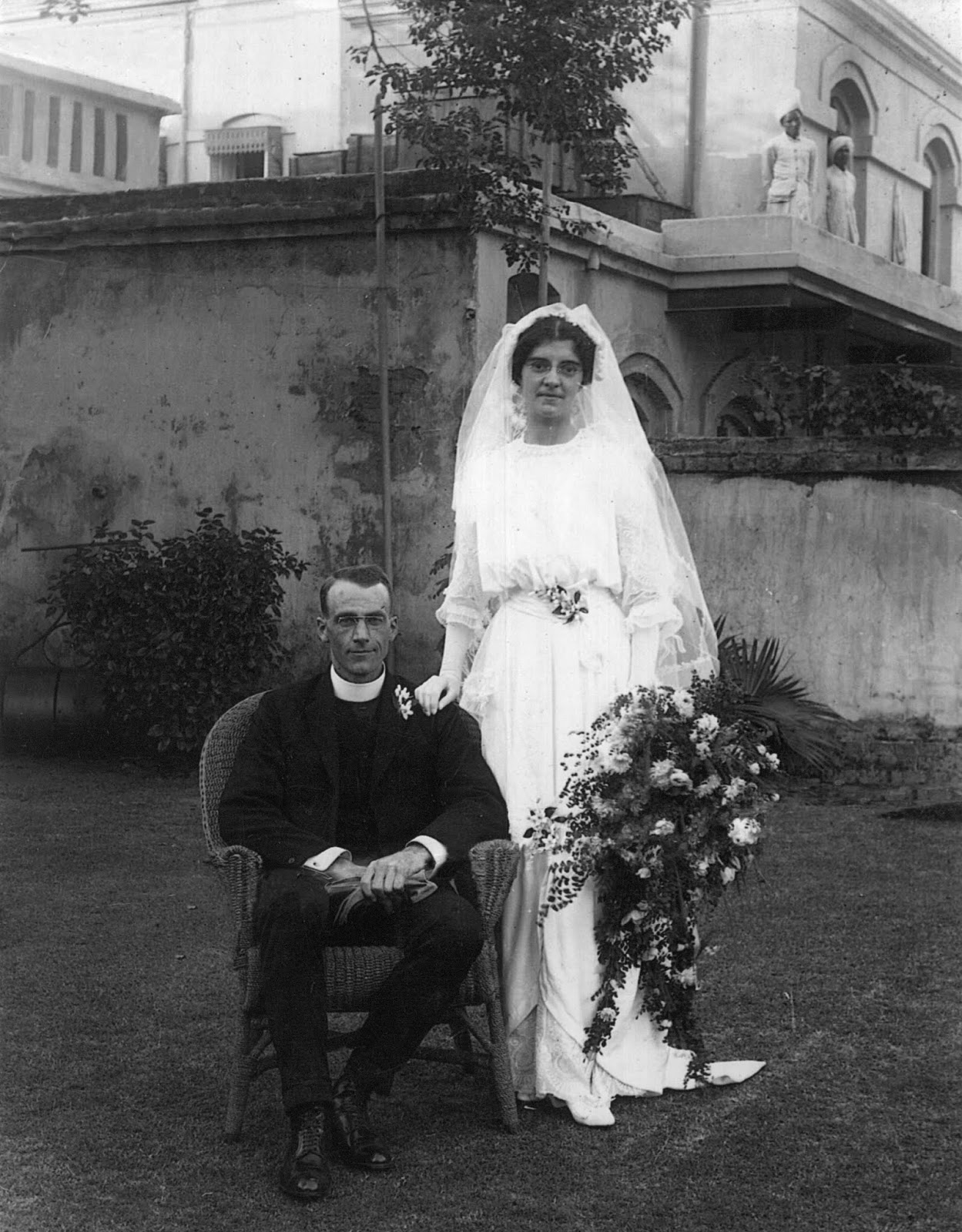
I was mystified why my mother, then living in Melbourne, Australia, wasn’t keen to talk about my missionary great aunt Florence “Florrie” Cox, whom we found pictured in this old photograph. My journalistic curiosity set me off on a 10-year investigation that led to my battling the Victorian Supreme Court in Melbourne to gain access to Florrie's divorce files which had been mysteriously and uniquely marked “Closed for all time”.


When the file was eventually shown to me, I discovered that my aunt had a very rare gender condition that had passed unnoticed in an era when the discussion of anything related to sex was considered a total taboo.

An affair by her husband with a fellow missionary caused such scandal that the Australian Baptist Church, with the co-operation of the court, the Freemasons and the media, mounted a hugely-successful cover-up.

My account of the investigation is revealed in God’s Triangle, available here in paperback or Kindle ebook: http://www.godstriangle.com/   

Saturday, 24 January 2015

A detective story dilemma

I have a particular problem with marketing and publicising my book God's Triangle. Briefly, the book is a chronological diary of my investigation into why there was such a mystery surrounding the break-up of my missionary Great Aunt Florence "Florrie" Cox's marriage. After a long battle that went all the way to the Supreme Court of Victoria, Melbourne, I discovered both the cause of the marriage breakdown and why the Baptist Church, the press and the Supreme Court colluded in a cover-up. Put simply, it is a true detective story.

The book reveals the cause of the marriage failure, but should potential readers be told this before they buy it? Before you react with "of course not", let me say that I fear I am missing out on a significant number of buyers with an interest and/or involvement in intersex issues by not explaining that Florrie was born with a very rare intersex condition and had no vagina.

When in Australian recently, I did a talk to a genealogy group and decided that I would reveal Florrie's problem -- the first time I had done so at a book talk. Despite this reveal, I sold all my books.

For various reasons not worth recounting, quite a few readers of God's Triangle did know about Florrie's problem beforehand. I asked a selection of them whether this had spoiled their enjoyment of the story. Most said it didn't because they enjoyed reading about it in more detail and because of the story's several other aspects. These included the explanation of how an intelligent and sensible person had been able to reach womanhood without knowing about menstruation or having any real idea how babies were made, how her husband and his second wife had been able to eradicate seven years from their troubled past while rising to become pillars of society, and how the scandal cover-up was organised.

God's Triangle is currently in development in Australia as a feature film and the producers have already decided that the audience should be told about Florrie's problem at an early stage. I think that is the right decision. It should mean that audiences feel emotionally engaged throughout, watching Florrie and her husband struggling to cope with a situation they don't fully understand. We shall see!

Feel free to offer your views, either on this page, or by contacting me by email at books@richardsonmedia.co.uk

If you wish to buy God's Triangle, here are the links for the paperback and the ebook.

Sunday, 4 January 2015

Wonthaggi, Australia: fond thoughts of a warm welcome

Although I spent just the first four years of my life in Wonthaggi, I have a tremendous fondness for the former coal mining town in Gippsland, Victoria. It is where my Scottish grandfather, John S. Richardson, a mining engineer, put down his roots after emigrating to Australia following the First World War. I never knew him because he died about two years before I was born, but from all reports, he was an entertaining and talented character with an interesting history. His death was brought about at the very early age of 54 by illnesses he caught when serving with the military in the Middle East. He was buried in the Wonthaggi Cemetery.

My father, also called John S. Richardson, was 10 when he arrived in Wonthaggi and after completing his schooling, he became an apprentice printer and later a reporter with the Wonthaggi Sentinel.

I was recently invited back to Wonthaggi by the local historical society to give a talk about my book, God's Triangle, which is currently being developed as a feature film. I was surprised at the large turnout for the talk, and I had a most enjoyable interaction with the audience. This is how the local newspaper, now called the South Gippsland Sentinel-Times, reported the visit:


And here's a story written about God's Triangle published in the South Gippsland Sentinel-Times of June 20, 2012:


:

Thursday, 18 September 2014

The story about, and the story behind, God's Triangle


GodsTriangle: A tale of love, loss and scandal in early 
20th Century East Bengal
From  UK Asian September 2014
    For the curious there's nothing quite like flipping through old family albums, delving into the past, exploring the stories of the men and women who went before.
    Ian Richardson is blessed with shiploads of that particular kind of curiosity.
    The former BBC journalist's curiosity was piqued no end one later winter's day in 1997 in his hometown of Melbourne, as he helped his recently-widowed mother sort through some old family photographs. 
    One photograph in particular caught Richardson's attention, one that would culminate, some fifteen years later, in 'God's Triangle', an extraordinary story about sexual and religious politics, cover ups and nefarious intrigues in early 20th century Australia and India. 
Florence Cox (Standing 2nd from Left)
    At the heart of this fascinating story are three even more fascinating characters, all Australian missionaries: Florence Cox, Richardson's great aunt, who was affectionately known as 'Florrie'; her husband the Reverend Frank Paice and Olga Johnston, one of the bridesmaids at Florrie and Frank's wedding.
    In October 1912, Frank Paice left Melbourne for East to join the scores of Baptist missionaries who were attempting to spread the word of god in the then-wilds of what would become Bangladesh.
    When not preaching, the missionaries were doing yeomen work in some of the sub-continent's poorest and most deprived communities.
    Frank had recently become engaged to Florrie, then aged 24. 
    Florrie had a certain languidness to her, unusually tall in comparison to her contemporaries and devoted to her work. 
    She would join her new husband in Calcutta, some two years later. 
    Their marriage however, endured - for a lack of a better word - in the malarial swamps of the Bengal, culminating in a scandalous divorce after five years: scandalous for numerous reasons. 
Above: Frank Paice and Florence Cox pictured after their wedding in Calcutta
    The astonishment that greeted this devoutly Christian couple's divorce was matched decades later by the evasiveness shown by Richardson's mother in 1997 as the journalist asked after 'Great Aunt Florrie'. 
    "The first thing my mother said when I asked about Florrie was, 'Oh we don't talk about her'.  She became visibly embarrassed and evasive", Richardson says.
    "I'd been a journalist for all these years so I wouldn't let it go.  I pressed and pressed and she said that Aunty florrie had been a missionary around the first World War and had married a missionary as well. 
    "And during that marriage, her husband had become involved with another woman who was also a missionary.  I was only a little girl and no one talked about it.  Initially I thought it was an interesting sidebar story.  But what I found out was astonishing".
    Whilst divorce among missionaries, in a largely conservative world was more than just unusual, the fact that the divorce had then been kept a secret was even more intriguing, a fact merely exacerbated by a mysterious illness that, Richardson would later find out, had afflicted Florrie: a condition that had had a direct impact on the marriage and one which would later lead to Florrie being ostracized by her family and community.
    "The first point for me was that no one had talked about the divorce there was no information about it", Richardson continues.
    "When I approached the Supreme Court of Victoria about it, they would not show me the file, which was quite remarkable.  I thought it was very odd and they were quite adamant that they not give me the file because they said that the judge at the time of the divorce had ordered for the file to be closed for all time.  Well that really did get me curious."
    The resolute Richardson pressed on.
    "The battle with the Supreme Court was a long one but the people in charge understood why I wanted the information and I think they sympathized with it.  It was a piece of Australian history and church history.  I nagged them and nagged them over several years until they got so fed up with me and said I could make an application to the Supreme Court. 
    "To my astonishment, the judge approved the application."
    The file would start a remarkable hunt. 
    When Frank and Olga's affair became known, both were forced to resign. 
Florrie, too, returned to Melbourne and found that she was suffering from a very rare gender condition which may have impacted on her marriage. After the divorce, Frank and Olga went to Calcutta where they were married in a discreet civil ceremony. 
    "Florrie never knew what was wrong with her.  She grew up in a very religious Protestant family in an age when sex was a totally taboo subject.  The first Florrie knew that something was wrong was on her honeymoon when she and her husband were unable to have intercourse.      The marriage never recovered from that. 
    "Florrie went to her grave in 1950 thinking she was some form of freak, getting little support from her embarrassed family or from the equally-embarrassed Baptist Church in Australia. Her actual condition was not given a name until after she died."
    Remarkably, the press was also told to ignore the whole affair and the file on the divorce ordered by a judge to be closed for all time.
    Florrie was shunned by her family who failed to understand the burden she had faced and following the general norm to blame the woman for the breakdown of the marriage. 
Frank and Olga in the meantime had returned to Bengal for different work - Frank had taken up an engineering management job - before returning to Australia as upstanding members of the community.
Above: Councillor Frank Paice and Olga later in life.
    In Australia that standing would reach phenomenal heights: the couple becoming regular fixtures in the social scene in their town and becoming prominent in civic society. 
The past was buried.  No mention was ever made of their time in India and, in particular, Frank's first marriage.  Not even their only son and close friends knew of their missionary past.
    'God's Triangle' is made up of a series of diary entries as Richardson travels to Calcutta and Bangladesh. 
    His curiosity and journalistic skill shines through as he trawls through myriad troves of documents. 
    During his research, Richardson also discovers that Frank and Olga had a son, Paul, who aids in Richardson's search, astonished at the double life his parents lived.
    The cover up is arguably the biggest aspect of the story.  How was it accomplished and who ordered it covered up?
    "This is a story that had everything.  It was scandalous.  How did Olga and Frank hide their past?  I think that was amazing.  I mean they were so prominent in suburban Melbourne society.  How did they manage to get away with people not asking about six missing years in their lives? 
    "Above all though, it was a cover up."
    Richardson suggests that the Baptist church - aided by the ever-present freemasons - went to elaborate lengths to sweep things under the carpet. 
    Despite its diary-like style, the book is gripping, not least due to Richardson's meticulous attention to the tiniest details. 
    At just over 150 pages long, it's not a big book by any means but it is crammed with information, shedding light on everything from the religiously conservative community that all three main characters hailed from to the remote part of East Bengal where carried out their extraordinary work.
    It's a book about religion and the dichotomy of the yeomen missionary work carried out by the likes of Frank, Florrie and Olga and the all-pervasive power of a church with medieval ideas about sexuality and personal freedoms.
    Above all, it's a book about tolerance and justice for a woman who was unfairly marginalized for a reason that those were doing the marginalizing had little understanding about: a problem that continues to blight humanity.
    Unsurprisingly, a story with such universal themes has caught the attention of a number of filmmakers.
    West London-based Richardson is in the final stages of scripting a multi-million dollar film project based on 'God's Triangle'. 


For more information, visit www.godstriangle.com

Tuesday, 16 September 2014

Does borrowing a book or buying one second-hand help the author?

The other day when I was searching for some family information in old Australian newspapers I came across this heart-felt advertisement in a provincial daily published in 1880:

It reminded me of an issue that must bother the overwhelming majority of authors: the fact that they get no financial return from books that are loaned to friends or family or are re-sold in second-hand bookshops or charity shops.

I have one friend who was so enthusiastic about my book God's Triangle that she bought a number of copies and gave them away as presents. That greatly cheered me, but there are a number of people who have written to tell me that they enjoyed the story so much they passed the book on to their friends to read. I'm sure they tell me this because they think it will please me. Yes it does -- up to a point.

Every author likes to know that all the hard work that has gone into a book is appreciated. There is no point writing something that no-one wants to read. But, the downside is that loaning books to friends undermines the often-meager financial returns for an author. Even best-sellers can result in very modest returns. A few months ago, I was at a talk given by an established writer who had authored several high-selling books and a screen play. These were listed in the chairwoman's introduction to the talk, to which he replied: "Thank you very much for reminding me of my works, but what I want to know is why haven't they made me rich?" I once asked a friend who wrote a highly-regarded book on Italian politics if he felt it had been worth it. "Well, I suppose so," he responded without enthusiasm, "but only if I try not to think about the fact that my royalties demonstrated that I'd worked for just 25p an hour!"

A real problem for authors are the charity shops -- especially those that deal almost exclusively in second-hand books. Hundreds of pounds can change hands each day in these shops, but none of it will go to the authors. Oxfam has a second-hand bookshop in Ealing Broadway, and I am convinced that it has played a part in the closure of two independent bookshops in Ealing in the past couple of months.

I now have to make an embarrassing confession. Looking through our own book shelves, I see that a substantial number of books have not been bought new at a bookshop or from Amazon. They have been given to us or we have bought them from a charity shop. And that is the real problem isn't it. It means that most authors will just have to be grateful that their books are being read by someone, even if the financial returns are not what they hoped.

Friday, 25 April 2014

Genealogy: the danger of trusting official documents

Newcomers to family history research can be forgiven for believing that official documents such as birth, death and marriage certificates are "gospel", so to speak. Not true.

When I was researching my book, God's Triangle, the story of a scandal involving my Baptist missionary Great Aunt Florence M. "Florrie" Cox, I came across the civil marriage record in Calcutta of her ex-husband and his mistress. The document contained several errors and misleading statements.

Even though the husband, Frank E. Paice, and his mistress, A. Olga Johnston, had been ordained missionaries, they were not above telling a few fibs. Olga gave her age as 32, just a year older than Frank, but three years younger than she really was. She wouldn't have been the first woman to lie about her age, but there was also a whopping deceit about how long she and Frank had been living in Calcutta. Frank claimed to have lived there for seven years, while Olga said she had been there for five years. This was blatantly untrue. They could not have been there for more than a few months as they had been in Australia for at least a year and before that, had been stationed for about six years in remote missionary outposts in East Bengal. Presumably they had lied because of residential requirements for their marriage.

There were several other aspects of the official record that could be seen as misleading, but I won't bore you with those. The point I want to make is that if the civil marriage record had been the first document I had found in my research, I would have been sent down routes that might never had led to me establishing the truth.

Similarly, anyone researching my Australian maternal grandfather, Arthur Joseph George Cox, would have been seriously mis-informed about his life had they gone first to his death certificate. His mistress-then-second-wife, Phyllis, had deliberately not mentioned that he had been married before and fathered 10 children, including my mother, Rena.

Not all errors in official family history documents are deliberate. Sometimes they are just careless mistakes. An example: the death certificate of my Great Aunt and opera singer, Reba Rangan, was wrong in several respects. For starters, Reba was her nickname, not her real name. Then her father was given as "unknown", which wasn't true. Her aunt was named as her mother, which also wasn't true, and it was further stated that she had spent all her life in Australia -- overlooking the fact she lived and worked in London for some time as an opera performer.

The death certificate details had been provided by a nephew and when I challenged him about the inaccuracies, he said simply that he had made no real attempt to establish the facts. He had just guessed most of the information.

I could give other examples of incorrect family history documents, but I hope that I have successfully made my point: treat all certificates with an element of caution.

+++++++++++++++

Learn more about the Rev Frank E. Paice by going HERE   
Learn more about A. Olga Johnson by going HERE
Learn more about Florence M. "Florrie" Cox by going HERE
Learn more about Reba Rangan by going HERE

Saturday, 12 April 2014

What comes first -- the book or the film of the book?

UPDATE: Since posting the message below I have received very useful suggestions about the need to make my book less like a film script. In view of this, I have made several changes (see the link towards the bottom of the page). Feel free to make any other suggestions that you feel might improve the telling of the story. Ian R
-----------------------------------------------------------------

As much as there are any hard and fast rules in the film-making business, it is the received wisdom that a book is written then someone else buys the film rights and turns it into a movie.

That's not the way it is with me, but then perhaps I am just perverse.

To be honest, I had never intended to become a screenwriter -- certainly not one so late in life after more than 40 years in print and broadcast journalism in Australia and the United Kingdom. Nor had it ever occurred to me that I might write a book. Quite the contrary. I always thought a book would require too much damned effort. But here I am, both screenwriter and book author and doing things in what many professionals think is the wrong way around.

But to go back a bit...

My first screenplay, GOD'S TRIANGLE, came about by accident. My wife, Rosemary, and I are keen genealogists and stumbled across the fascinating and sad story of my Australian Great Aunt Florence "Florrie" Cox. Florrie was a Baptist missionary in East Bengal (now Bangladesh) during the First World War, and as the story emerged of why her marriage to the Rev. Frank E. Paice went into meltdown, Rosemary recognised its potential as a feature film.

I sold the idea to an official of  Film Victoria, the Victorian State Government film agency in Melbourne. But pitching an idea to someone who thinks it is a great idea is the easy bit. In my case, I also naively believed that a total of seven years in television news qualified me to write the script for a film lasting between 90 and 120 minutes. Wrong. So wrong. My first attempt at a script was truly terrible, chiefly because it was dialogue driven and gave away too much information too early. Gradually I got the hang of screenwriting, but still no-one came forward with a firm offer.

The turning point came when Rosemary pointed out that I should be drawing up a detailed chronological account of our God's Triangle research for the historical record. This soon morphed into diary that became a paperback and ebook. And that did the trick. Once that was published, the interest grew and the film rights were picked up. The screenplay is now in pre-production development with two producers in Melbourne, financed by Film Victoria.

This got me thinking about my three other screenplays -- in particular The Moral Maze, a fictional thriller about a foreign correspondent corrupted by the intelligence services with disastrous consequences. Why not also write the book version of this story, I wondered? And that's what I am now doing, in the hope that its publication will lead to the screenplay being picked up by someone with access to about $US10m.

The book should be published before next Christmas. I'm just loving writing it because it requires such a difference approach to a film script. If you interested in making the comparisons, I have posted the opening scenes and chapters on my main Richardson Media Limited website. Here are the LINKS to the SCREENPLAY and to the BOOK.

Feel free to send me your comments to me: ian*at*richardsonmedia.co.uk

PS: Sorry that I can't give you a link to any extracts of the God's Triangle screenplay at this stage, but the script is again a work in progress and currently subject to commercial confidentiality.