Showing posts with label genealogy. Show all posts

Monday, 2 December 2024

An accidental history

I've always liked writing, even before I became a journalist, so when my wife, Rosemary, and I came to the UK  from Melbourne, Australia in 1968, I wrote a detailed diary of the journey. Once we reached London, I sent a copy of the diary to my family back in Australia. I then, over the following decades, wrote to the family at least once a week. They were what could be termed "journalistic letters". By that I mean they contained illustrative detail, not just simple uninformative statements such as "We went to a local museum yesterday. Very nice".

I wrote the letters and travel diaries without giving a thought about how important they would become years later. Before my mother died she revealed that she had kept all my letters and diaries and gave them back to me. I then realised I had a detailed written history of my family from 1968 onwards. They made a wonderful read, but there was more than that as you will see from the message I have posted on Substack: 


Here is the index to the chapters posted so far: https://iandrichardson.substack.com/archive

Monday, 5 September 2022

Family history triggers

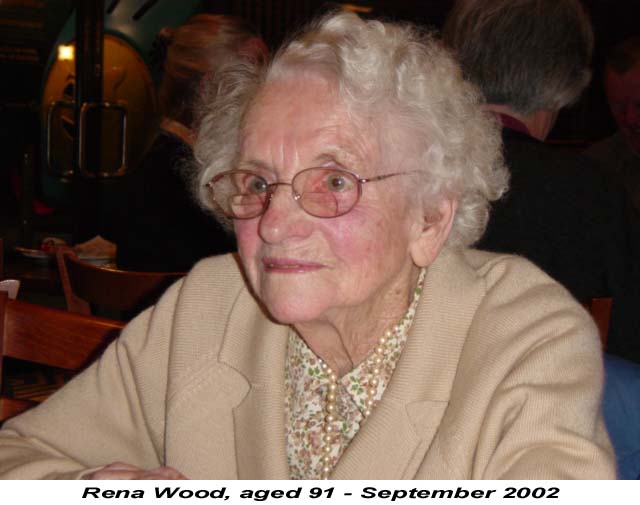
My mother, Rena Wood, formerly Richardson née Cox, spent her life in Australia and was a keen family historian. 

In her eighties she began Triggers, a collection of short accounts of events that had been significant in her life. They were written over a couple of years whenever something triggered a memory. It was a great idea and a wonderful alternative to the huge effort in writing and printing a book.

This is how my mother explained Triggers

How often I wonder, do we realize that small things such as noises, colours, words, pictures, smells, a chance remark from a friend or neighbour, even an item of news in the daily paper or magazines, something on TV or Radio recall to mind some event or incident, that happened in our childhood or in the years past? These things act as triggers to our memory and can be recalled when we have not thought about the experience or happenings for many years.

Here are some of her entries:

I recall, as a girl living in Melbourne, going to the city to see the procession of the Duke and Duchess of York through the city. The duke was then going to the Exhibition Building for some ceremony, but the duchess was returning to Government House and travelling in an open car down Spring Street. I was one of many children who ran halfway down Spring Street, wildly waving to the most gracious lady, now the Queen Mother.

Bad thunderstorms, bring to my mind our early fears, and how we would get into Mother's bed, or she into ours, to comfort us. Her way was to make us use our imaginations and describe to her what we thought it sounded like. A load of bricks falling down? The petrol tins? There were no petrol bowsers in my childhood, and the [four gallon] tins were piled high in the garage or shed and were being thrown about by the wind. Or would it be piles of crockery being dropped and broken? Rocks being dropped on glass or a window broken? It was not very long before we were imagining so many things, that the terror of the thunder and lightning had passed away.

 As a mother of four children, in a country town [Charlton, Victoria], my children dug trenches in the back yard, lined them with wheat and sugar bags, and with old blankets settled themselves down for the night. They had used sheets of galvanised roofing iron, to cover the trenches, to protect themselves from damp and rain, but not counted on the whippet dogs, owned by the next door neighbour, getting into our yard and walking over the iron sheets to investigate. From memory I think they survived out there until about 9pm, when they were happy to come inside to their own warm beds.

The T.V. pictures last year showing the great clouds of dust coming from the country to the city, clearly demonstrated to the city folk what all the words in the world failed to tell, of the problems of the early 1940s, when droughts for years at times caused the sun to be blacked out during the daytime. The worst [dust] storm I remember, the children were sent home from school [in Charlton] at lunch time, and by 2pm it was pitch dark, the street lights were put on, the fowls went to bed thinking it was night. Cars used their headlights and travelled slowly as it was impossible to see the shops on either side of the road.


Wednesday, 15 April 2020

The importance of genealogy


One of my more insensitive friends once told me that genealogical research was akin to train spotting. Rubbish. Family history research requires the instincts of an ace detective and a fascination for knowledge about our historical context. 

Would I have taken such an interest in the causes of the First World War and the horrors it caused had I not learnt that my maternal grandfather, Arthur J. G. Cox, was gassed on the Western Front in 1917? Probably not. Would I have learnt anything about airships if I hadn't discovered that my other grandfather, John S. Richardson, had been chief inspector on the famous R34 airship? No. Would I know anything about the shocking Highland clearances in Scotland if several of my wife’s ancestors not be driven from their homes by greedy land owners anxious to replace people with sheep? Not likely. 

Now tell me what I would have learnt about life if I had spent my days gathering locomotive numbers? Nothing of historical importance.

Friday, 10 April 2020

Genealogy: The complexity of marriages and other sexual relationships


Modern society’s broad acceptance of cohabiting couples and children born out of wedlock is creating a severe headache for genealogists who love to see their ancestors’ families neatly laid out.  

Previous ages, though often dominated by strict church dogma, had more than their share of de facto marriages and births judged to be “illegitimate”, but nothing compares with the present time. 
      
One of my friends had three marriages and at least two settled cohabiting relationships. Another friend married the same woman twice with a divorce and a 10-year gap between the marriages.  And I know of another man who married the same woman twice with a divorce and another marriage and divorce in between.

These examples of multiple relationships are raising serious challenges for family historians. At what point, for example, does a sexual relationship become formally recognised? Is it when they move in together? When they have been together, say, for a year? When they get married, if they ever do?

It’s a nightmare.

Then there is the related issue of homosexual relationships, both male and female. If a same-sex couple moves into an established relationship, should that become part of the family tree, no matter how messy it might be judged in genealogical terms? I think it should. So, what would I then do if a lesbian relative not only married another woman, but with the aid of artificial insemination, had children? Would I skirt around the subject and write “father unknown”? And finally, what should go on the family tree when a traditional male-female couple have a child whose natural father was a sperm donor?

Questions, questions, questions. But no simple answers.

-----------------------------------------------------------------------------------------
The book resulting from a story I stumbled across while researching my family history:


Tuesday, 3 January 2017

Writing a family history

From time to time I am asked to address genealogical groups about how to preserve their family history. These are my notes, which some of my readers may find useful:
  1. Be truthful, accurate and fair, even if some elements can’t be made public until after the death of a person, or at some other time in the future. Check your facts, as best you can. If you can’t be sure of something, say so. Do not present guesswork as fact.
  2. Avoid sweeping statements that give no details. Don’t say he was an amusing/ill tempered/nice/intelligent person without saying why and giving examples. Avoid making statements like “she went to Smithville and hated it” without revealing why. Also explain what you mean if you say something like “he was good at golf/liked reading books/was keen on art”.
  3. Try to think ahead and ask yourself if following generations will understand what you have written? Make sure that acronyms and initials are spelt out at least once, in case they mean nothing a century or two from now. Be careful of slang that won’t mean anything in the future.
  4. Brackets. Understand the difference. These ( ) are mostly for asides in your own writing, such as “I went to Walpole Park (that’s the park alongside Mattock Lane) and…”  These [ ] are for inserting information in documents prepared by someone else. Example: “Jane worked for Goodwin’s [a shop in Smithtown owned by her brother Frederick] before going on…”
  5. Digitise documents where possible and make sure they are backed up.
  6. Use acid free paper for very important archive documents. More importantly, keep records away from bright light, damp, or hot and humid storage places.
  7. Scan and digitise favourite photographs in high-resolution (at least 300dpi) and always write a caption on them. Use Photoshop or cheaper alternatives for this.  Always back up family history documents and photographs in more than one location.
  8. Photobooks are a good and reasonably cheap way to make a permanent record of a person or family.
  9. You may want to write a book about the person or the family, but if you want it to go into libraries or bookshops, apply for an International Standard Book Number (ISBN) from Nielsen. Here is a link to my book God's Triangle that is the result of my family history research into the life of a missionary great aunt.
  10. If authoring a book seems too daunting, write brief stories or anecdotes as they occur to you. My mother did this and called her wonderful collection Triggers.
  11. Another option: write an obituary/profile/biography and post it on the Internet. I was unhappy about the obituary written about my father at the time of his death because it didn’t really say anything significant about the man. I wrote to a number of the people who knew him and asked for their honest opinions of his character. This is what I wrote about my father, John S. Richardson, as a result of the contributions.  Here are the obituaries published about my mother, Rena M. Wood.
  12. Finally, a warning: Do not post private information about living persons on the Internet if this information could be used by hackers or by people trying to steal identities.
(c) Ian D. Richardson

Sunday, 4 January 2015

Wonthaggi, Australia: fond thoughts of a warm welcome

Although I spent just the first four years of my life in Wonthaggi, I have a tremendous fondness for the former coal mining town in Gippsland, Victoria. It is where my Scottish grandfather, John S. Richardson, a mining engineer, put down his roots after emigrating to Australia following the First World War. I never knew him because he died about two years before I was born, but from all reports, he was an entertaining and talented character with an interesting history. His death was brought about at the very early age of 54 by illnesses he caught when serving with the military in the Middle East. He was buried in the Wonthaggi Cemetery.

My father, also called John S. Richardson, was 10 when he arrived in Wonthaggi and after completing his schooling, he became an apprentice printer and later a reporter with the Wonthaggi Sentinel.

I was recently invited back to Wonthaggi by the local historical society to give a talk about my book, God's Triangle, which is currently being developed as a feature film. I was surprised at the large turnout for the talk, and I had a most enjoyable interaction with the audience. This is how the local newspaper, now called the South Gippsland Sentinel-Times, reported the visit:


And here's a story written about God's Triangle published in the South Gippsland Sentinel-Times of June 20, 2012:


:

Sunday, 28 September 2014

Genealogy & family history research: Lessons to learn from the Aussies

Let me offer a huge recommendation for the Australian newspaper archive, Trove. It is brilliant, and I choose this word carefully.

Trove is run by the Australian National Library and if you are attempting to track down information about your relatives in Australia, it is an excellent starting point. It is free and navigation around the immensely-informative resource can be learned very quickly. Another plus is that new material is being added every day. The only downside is that it becomes quite addictive, but what fun!

Now, let me turn to the British equivalent, the British Newspaper Archive. This is no -- repeat no --  fun at all. It is infuriatingly and quite unnecessarily difficult to navigate and, further, makes corrections to the text very difficult. Add to this, you have to pay to access it. It is incredibly user-unfriendly and you have to wonder if it was ever beta tested on the public. I bet it wasn't. I spent the best part of an hour rummaging around the archive this afternoon. There is just one word to describe my experience as I bang my head against the wall in frustration: Aaaaaaaaagh!!!!!!!!

UPDATE: Coincidentally (?) my Facebook page came up with a sponsored posting from the British archive, but when I posted a complaint about the site, it was promptly deleted. And when I complained about the deletion, it was also deleted. So much for free speech at this British institution.

SECOND UPDATE: If you take out a subscription to the archive, be careful that a month's subscription doesn't become open ended. Make sure you read the small print "Your subscription is sold on a continuous membership basis, meaning it will continue until you cancel it." and hunt down and untick the automatic renewal.


Sunday, 3 August 2014

The threat to our pictorial history posed by digital photography


“More means less” is a truism that applies to many areas of life – but never more so than with present-day digital photography.

It is safe to estimate that billions of digital photographs are taken around the world each day, but almost none will ever become part of a family history archive. They are here today and gone tomorrow.

There was a time, not that many decades ago, when taking a photograph was an event from which the results were treasured.

The photographs from these sessions were archive quality and became proud possessions to be passed on from generation to generation.

We must all know friends and family who indiscriminately fire away with their digital cameras and smartphones with the enjoyment being for the moment.

Some of these photographic efforts are emailed to friends and family, or are posted on Facebook, Twitter, Instagram, Flickr and other social media outlets. They are very rarely turned into prints that can be held in the hand and admired, or put in a frame or even a photo album.

Click here to see my full article published in Family Tree magazine, which is a very useful read for anyone interested in researching their family history. 

Friday, 25 April 2014

Genealogy: the danger of trusting official documents

Newcomers to family history research can be forgiven for believing that official documents such as birth, death and marriage certificates are "gospel", so to speak. Not true.

When I was researching my book, God's Triangle, the story of a scandal involving my Baptist missionary Great Aunt Florence M. "Florrie" Cox, I came across the civil marriage record in Calcutta of her ex-husband and his mistress. The document contained several errors and misleading statements.

Even though the husband, Frank E. Paice, and his mistress, A. Olga Johnston, had been ordained missionaries, they were not above telling a few fibs. Olga gave her age as 32, just a year older than Frank, but three years younger than she really was. She wouldn't have been the first woman to lie about her age, but there was also a whopping deceit about how long she and Frank had been living in Calcutta. Frank claimed to have lived there for seven years, while Olga said she had been there for five years. This was blatantly untrue. They could not have been there for more than a few months as they had been in Australia for at least a year and before that, had been stationed for about six years in remote missionary outposts in East Bengal. Presumably they had lied because of residential requirements for their marriage.

There were several other aspects of the official record that could be seen as misleading, but I won't bore you with those. The point I want to make is that if the civil marriage record had been the first document I had found in my research, I would have been sent down routes that might never had led to me establishing the truth.

Similarly, anyone researching my Australian maternal grandfather, Arthur Joseph George Cox, would have been seriously mis-informed about his life had they gone first to his death certificate. His mistress-then-second-wife, Phyllis, had deliberately not mentioned that he had been married before and fathered 10 children, including my mother, Rena.

Not all errors in official family history documents are deliberate. Sometimes they are just careless mistakes. An example: the death certificate of my Great Aunt and opera singer, Reba Rangan, was wrong in several respects. For starters, Reba was her nickname, not her real name. Then her father was given as "unknown", which wasn't true. Her aunt was named as her mother, which also wasn't true, and it was further stated that she had spent all her life in Australia -- overlooking the fact she lived and worked in London for some time as an opera performer.

The death certificate details had been provided by a nephew and when I challenged him about the inaccuracies, he said simply that he had made no real attempt to establish the facts. He had just guessed most of the information.

I could give other examples of incorrect family history documents, but I hope that I have successfully made my point: treat all certificates with an element of caution.

+++++++++++++++

Learn more about the Rev Frank E. Paice by going HERE   
Learn more about A. Olga Johnson by going HERE
Learn more about Florence M. "Florrie" Cox by going HERE
Learn more about Reba Rangan by going HERE