Showing posts with label Australia. Show all posts

Tuesday, 16 January 2024

Publishing an autobiography bit by bit

I've had three books published since retiring from BBC World Service radio and television and have contributed to several others.  They have involved much more work than I anticipated. Hence, I was not that keen when pressed to write an autobiography. Then I had an idea. The solution lay by publishing my story chapter-by-chapter with Substack. The link to my chapters so far is HERE

Ian R

Saturday, 21 October 2023

The lovely singer and TV star Cilla Black

Back in the 1970s and 1980s I did lots of celebrity interviews for Australian radio, magazine and newspaper outlets. Sadly, I didn't keep all of them, but I recently came across this one with the Liverpudlian singer and TV star, the late Cilla Black. It was recorded in advance of a concert tour of Australia and New Zealand. Despite her fame, there was no "side" to her and it was one of my most enjoyable meetings with a celebrity. Here's the link to my uncut recording which I have loaded onto my website: Cilla Black interview

Tuesday, 2 March 2021

How some of us got driving licences in the old days

From time to time I hear from relatives and friends in my birthplace, Australia, about the expense and involved process for their children to get a driving licence. There are P (for Provisional) plates, 120 hours of supervised driving over months, driving logbooks, a very tough theory test, and substantial test fees. And that's just a most basic summary.

How different from when I got my driving licence in rural Victoria in the late1950s...

Our first family car was a second-hand Vauxhall sedan, bought by my mother, Rena, after the death of my father, John S. Richardson. I have no idea how she got a licence, but she would never have won any driving prizes. As for my licence, I think it was awarded by Snr. Const. Pat Nally, father of my old schoolmate, Ian Nally. 

There was an old registration number plate nailed to a tree in the local police station driveway. Before setting out on the driving test, the hopefuls had to prove their eyesight by reading the number plate from the entrance to the driveway. Those who were unsure about their eyesight would turn up early, sneak up to the licence plate and memorise it. 

As for proving that you could drive, that was easy. In my case, Snr. Const. Nally sat in the back seat of our Vauxhall and instructed me to drive to what was known as the "low bridge" over the local river, the Avoca. At the bridge's lowest point, I was instructed to turn off the engine, put on the handbrake, turn the engine back on, and do what was called a "handbrake start" up the other steep side of the bridge, without stalling and rolling back down the bridge. We then returned to the police station where I was issued with a free driver's licence without further examination or restriction. I don't recall having to do a theory test; it was simply assumed that I understood the rules of the road, such as they were. The most important thing when seeking a driving licence was to avoid terrifying the policeman whose job it was to conduct the test.

With the passage of time I have forgotten who taught me to drive. It certainly wasn't a professional driving instructor because there were none in the town, nor in many towns and cities in Australia. I think I was given basic instruction by a couple of visiting uncles. All motor vehicles back then were manual, and I remember the most difficult part of driving was learning the skill of double-declutching when having to return the engine from second to first gear. 

Driving on Australian roads at that time could be quite dangerous, even though speeds were not particularly high. There were no seat belts, no speed cameras, and no breathalysers. Drinking and driving was very common, and drivers had to be in a considerable state of intoxication and driving in a spectacularly erratic manner before finding themselves before the courts. If drivers did get booked for speeding, it was because the local copper didn't have much to do and decided to follow someone considered to be driving too fast and book them on the basis of the speedo on the policeman's own car.

I've not enjoyed driving in Australia on my many trips back there. This is chiefly because Aussie drivers can be dangerously aggressive. There is none of the politeness seen on most roads in the UK. I don't know why this is so, but I suspect that a prime reason is that the speed restrictions are often all over the place and immensely frustrating. Anyone travelling along many a main road in Melbourne, for example, will encounter ever-changing speed limits, some of them changing according to the  time of day. Most Australian drivers accept speeding fines as an significant part of their life on the roads. 

One thing I do agree with, though, is the random breath testing, which has brought about a dramatic drop in drink driving in Australia. I have been breath tested just twice in my life -- both times in Australia. On one occasion I was in a city and had just enjoyed a dinner with some friends at a pub. Fortunately, I'd had just one glass of very low alcohol beer, so I was okay. The other occasion was on a very quiet bush road at 10am. When I asked the copper why they were carrying out random tests at that time of the day on a little-used road he replied "You'd be surprised, Sir, how many drivers are over the limit at this time of the day and don't think they will be caught."

================

I did wonder if getting my driving licence was not as easy as I remembered, so I went onto the website for the town where I grew up and asked if anyone had similar experiences. There were lot of responses recounting similar stories. Here are a few:

My driving test was the same but when we got back to the station, the Sergeant gave me a Car, Motorcycle, Tractor and a small truck license......Why??? Because he’d seen me driving them all and thought I should have them. I had heard of others that got the same..... We didn’t have to do the vision test but a group of us young blokes got dragged down to the wreckers to see a bad accident with blood and bits all over the car. It made us slow down a bit. I can still remember the sight, not very nice but it worked.

I drove around for no more than 20 minutes, did a handbrake start on the sloping road up to the station, reversed out of an angle park outside State Savings Bank and read the number of the house opposite the Police Station. 1967.

The policeman was slightly intoxicated, only had civvies on, he put his police hat up the back window of the car, for good looks, a quick drive around the block, back to the police station, no questions asked and I got handed my licence. That certainly wouldn't happen today.

The day I turned 18 in 1983, Dad took me down to the cop shop in Mum’s yellow Ford Laser. After driving around the town for 5 minutes with the cop more interested in the Fleetwood Mac cassette we were playing, I had my licence. 

Remember my friend who I will not name she went for her license in an automatic car. And yes she had to do a hand break start at the low water bridge which she near reversed off the bridge. The copper at the time said you need a little more practise at that but she got her license. 

Wednesday, 14 August 2019

Travelling Down Under: How to translate Strine, Australia's national language.

The first 30 years of my life were spent in Australia and since moving to London, I have made at least one trip every year to the land of my birth. But despite the frequency of my visits, I am increasingly finding it difficult to understand the language.

It now seems that most descriptive names in Australia are reduced to words ending in “o” or “ie”.

Over the years I have become  accustomed to “arvo” (afternoon), “tinnie” (can of beer or a small tin boat), "cossie" (swimming costume) “rellie” or “rello” (a relative) and being referred to as a “journo” (journalist), but what was I to make of a headline in the Australian papers about a man’s leg being chewed off by a “saltie”? 

I found that answer only by reading well down into the story and learning that a “saltie” is a salt water crocodile. I also noted that the man with the chewed leg was in a critical condition in “hossie” (hospital).

On one recent trip, I was challenged by a large illuminated sign over a highway “Have you renewed your rego?” My immediate response was to shout: “Well, I might renew it if I knew what it was”. A friend later enlightened me. “Rego” was short for car registration, the Australian equivalent of the UK’s road tax. 

I note in recent emails the increasing use of "renos". This turns out to be the Strine short form for renovations. 

Some of this word reduction and slang is amusing, and I couldn’t help smiling when I learned some time ago that “carked it” meant that someone had died (i.e. become a carcass). On a recent trip to my homeland several people used "carked" in their conversion, such as "Did you know that old Fred had 'carked' it?" 

I also love the much-used “hoon”, the short form of hooligan, and “rort”, the term most frequently applied to phoney expenses and rip-offs by politicians (“pollies”).

What surprises me is how the slang has been adopted in recent years by Australia’s mainstream media. 

It is common, indeed usual, for Australian newspapers to refer to “firies” (firemen), ambos (ambulance drivers), and “schoolies” (drunken end-of-school-year parties).

Scanning the Australian papers on the internet the other day I also came across “tradie” (tradesman, such as plumber, electrician and carpenter), “boatie” (someone with a small boat), “yachtie” (a yachtsman) and “servo” (a motor vehicle service station).

And then there are the slang words that pop up in emails and social media postings from my friends (“mates” is preferred) and relatives (sorry, rellos) in "Godzone" (Australia): There is “bowlo” (member of a lawn bowls club), “sando” (sandwich) and “trannie” (no longer a transistor radio; now a transexual). Also, a friend reported that their child had a "tantie" (tantrum).

I received an email from a friend who apologised for failing to "corro" recently. Corro? Yes, of course. That turned out to be the short form for "correspond". He told me that he had been busy with the builders brought in to do some "renos" (renovations).

I recently tore my hamstring in a fall. I received several sympathetic emails from Australian friends in which they referred to my "hammy". 

Finally, I should tell you about a recent email in which a women friend heaped praise on her “gynie”. No doubt, by now, you will have decoded this to be a reference to her gynaecologist.

------------------------------------------------------
And how did the Aussie accent come about? Here are some suggestions:
http://www.theregister.co.uk/2015/10/28/drunken_slurring_aussies_strine_forefathers/ 

Sunday, 19 November 2017

Dangerous Australia

Someone - I don't know who - came up with this amusing Aussie road sign. It is meant as a joke, but there is a significant element of truth in it. When my siblings and I grew up in the bush in south-eastern Australia, we learned very soon to be wary of snakes, particularly in the warmer weather. It was also in the age of outside "dunnies" (Australian term for lavatory/toilet/loo) and we knew to always check under the dunny seat to make sure there were no poisonous red backed spiders lurking there.

Later, when I moved to Melbourne, light aircraft sponsored by local radio stations kept a watch on hot days for sharks swimming close to the many local beaches, but at least Melbourne wasn't one of those parts of Australia populated by crocodiles happy to have a human snack.


This sign prompts me to link to my earlier posting about whether the land of my birth is relatively free of crime and other social problems. The answer in a word is "no". Read on to discover the proof of my claim: Godzone & crime. 

Saturday, 5 August 2017

Thank you, Blonde Lawyer

As any author will tell you, writing a book is a long and often-tedious task. Then there's the problem if getting it published and circulating it in the great wide world in competition with hundreds of thousands of other books. Therefore, I am pathetically grateful whenever I get a four or five star reviews.  Here's one from someone who appears to write from the heart:

Thank you, Blonde Lawyer, whoever you are, wherever you are, for this Amazon review of my true story of scandal and cover-up called God's Triangle


And here is one of the other very nice reviews:

And now if you want to read some of the other God's Triangle reviews and comments, go here


Friday, 17 July 2015

Planning a trip to Australia (Oz)? Better learn some Strine! UPDATED

The first 30 years of my life were spent in Australia and ever since moving to London, I have made at least one trip every year to the land of my birth. But despite the frequency of my visits, I am increasingly finding it difficult to understand the language.

 It now seems that most descriptive names in Australia are reduced to words ending in “o” or “ie”.

Over the years I have become  accustomed to “arvo” (afternoon), “tinnie” (can of beer or a small tin boat) , "cossie" (swimming costume) “rellie” or “rello” (a relative) and being referred to as a “journo” (journalist), but what was I to make of a headline in the Australian papers about a man’s leg being chewed off by a “saltie”? 

I found that answer only by reading well down into the story and learning that a “saltie” is a salt water crocodile. I also noted that the man with the chewed leg was in a critical condition in “hossie” (hospital).

On one recent trip, I was challenged by a large illuminated sign over a highway “Have you renewed your rego?” My immediate response was to shout: “Well, I might renew it if I knew what it was”. A friend later enlightened me. “Rego” was short for car registration, the Australian equivalent of the UK’s road tax. 

Some of this word reduction and slang is amusing, and I couldn’t help smiling when I learned some time ago that “carked it” meant that someone had died (i.e. become a carcass). On a recent trip to my homeland several people used "carked" in their conversion, such as "Did you know that old Fred had 'carked' it?" 

I also love the much-used “hoon”, the short form of hooligan, and “rort”, the term most frequently applied to phoney expenses and rip-offs by politicians (“pollies”).

What surprises me is how the slang has been adopted in recent years by Australia’s mainstream media. 

It is common, indeed usual, for Australian newspapers to refer to “firies” (firemen), ambos (ambulance drivers), "fishos" (fisherman) and “schoolies” (drunken end-of-school-year party).

Scanning the Australian papers on the internet the other day I also came across “tradie” (tradesman, such as plumber, electrician and carpenter), “boatie” (someone with a small boat), “yachtie” (a yachtsman) and “servo” (a motor vehicle service station).

And then there are the slang words that pop up in emails and social media postings from my friends (“mates” is preferred) and relatives (sorry, rellos) in "Godzone" (Australia): There is “bowlo” (member of a lawn bowls club), “sando” (sandwich) and “trannie” (no longer a transistor radio; now a transexual). Also, a friend reported that their child had a "tantie" (tantrum).

I received an email from a friend who apologised for failing to "corro" recently. Corro? Yes, of course. That turned out to be the short form for "correspond". He told me that he had the builders in to do some "renos" (renovations).

I recently tore my hamstring in a fall. I received several sympathetic emails from Australian friends in which they referred to my "hammy". 

Finally, I should tell you about a recent email in which a women friend heaped praise on her “gynie”. No doubt, by now, you will have decoded this to be a reference to her gynaecologist.

------------------------------------------------------
And how did the Aussie accent come about? Here are some suggestions:
http://www.theregister.co.uk/2015/10/28/drunken_slurring_aussies_strine_forefathers/ 

Monday, 2 March 2015

An above-Everage honour

Strewth! I'm a Dame Edna favourite!

Just before Christmas, I posted a fairly routine tweet about Dame Edna Everage appearing on BBC Radio Four's Today Programme. Now, after all this time, I get this message (see below). Can there be any greater honour for an Australian?


Top of Form
Back in the Dim Dark Ages (the 1970s) I used to freelance as the London correspondent for Australia's TV Week magazine. I got to know Barry Humphries a bit before he became seriously famous outside Australia. Sometimes when I would ring him, "Edna" would answer the phone and tell me that "Mr Humphries is busy just at the moment, but he will call you back as soon as he is free" -- and he would, returning the call as himself. 

We would sometimes chat about his Private Eye strip, The Adventures of Barry McKenzie, and make up deliberately-crude Aussie sayings. One of these, I remember, was "Go stick your head up a dead bear's bum". 

On one occasion, at a social function in London, Barry/Edna agreed to do a radio interview (for 3AW, Melbourne, I think) and the only quiet place we could find was the men's toilet. Fortunately, no-one burst in on us during the interview, as there would have been a lot of explaining to do.

Barry never liked being interviewed as Edna unless dressed in character. However, on this occasion I remember that he was wearing a dinner jacket. I wish I still had that interview, but it was back in the days when 1/4" recording tape was expensive and was bulk erased after being broadcast. However, I still have a copy of one interesting (mostly serious) interview with Barry done in January 1970 before he became seriously famous. 


Wednesday, 18 February 2015

A mystery solved, but only after a long investigation

I was mystified why my mother, then living in Melbourne, Australia, wasn’t keen to talk about my missionary great aunt Florence “Florrie” Cox, whom we found pictured in this old photograph. My journalistic curiosity set me off on a 10-year investigation that led to my battling the Victorian Supreme Court in Melbourne to gain access to Florrie's divorce files which had been mysteriously and uniquely marked “Closed for all time”.


When the file was eventually shown to me, I discovered that my aunt had a very rare gender condition that had passed unnoticed in an era when the discussion of anything related to sex was considered a total taboo.

An affair by her husband with a fellow missionary caused such scandal that the Australian Baptist Church, with the co-operation of the court, the Freemasons and the media, mounted a hugely-successful cover-up.

My account of the investigation is revealed in God’s Triangle, available here in paperback or Kindle ebook: http://www.godstriangle.com/   

Thursday, 18 September 2014

The story about, and the story behind, God's Triangle


GodsTriangle: A tale of love, loss and scandal in early 
20th Century East Bengal
From  UK Asian September 2014
    For the curious there's nothing quite like flipping through old family albums, delving into the past, exploring the stories of the men and women who went before.
    Ian Richardson is blessed with shiploads of that particular kind of curiosity.
    The former BBC journalist's curiosity was piqued no end one later winter's day in 1997 in his hometown of Melbourne, as he helped his recently-widowed mother sort through some old family photographs. 
    One photograph in particular caught Richardson's attention, one that would culminate, some fifteen years later, in 'God's Triangle', an extraordinary story about sexual and religious politics, cover ups and nefarious intrigues in early 20th century Australia and India. 
Florence Cox (Standing 2nd from Left)
    At the heart of this fascinating story are three even more fascinating characters, all Australian missionaries: Florence Cox, Richardson's great aunt, who was affectionately known as 'Florrie'; her husband the Reverend Frank Paice and Olga Johnston, one of the bridesmaids at Florrie and Frank's wedding.
    In October 1912, Frank Paice left Melbourne for East to join the scores of Baptist missionaries who were attempting to spread the word of god in the then-wilds of what would become Bangladesh.
    When not preaching, the missionaries were doing yeomen work in some of the sub-continent's poorest and most deprived communities.
    Frank had recently become engaged to Florrie, then aged 24. 
    Florrie had a certain languidness to her, unusually tall in comparison to her contemporaries and devoted to her work. 
    She would join her new husband in Calcutta, some two years later. 
    Their marriage however, endured - for a lack of a better word - in the malarial swamps of the Bengal, culminating in a scandalous divorce after five years: scandalous for numerous reasons. 
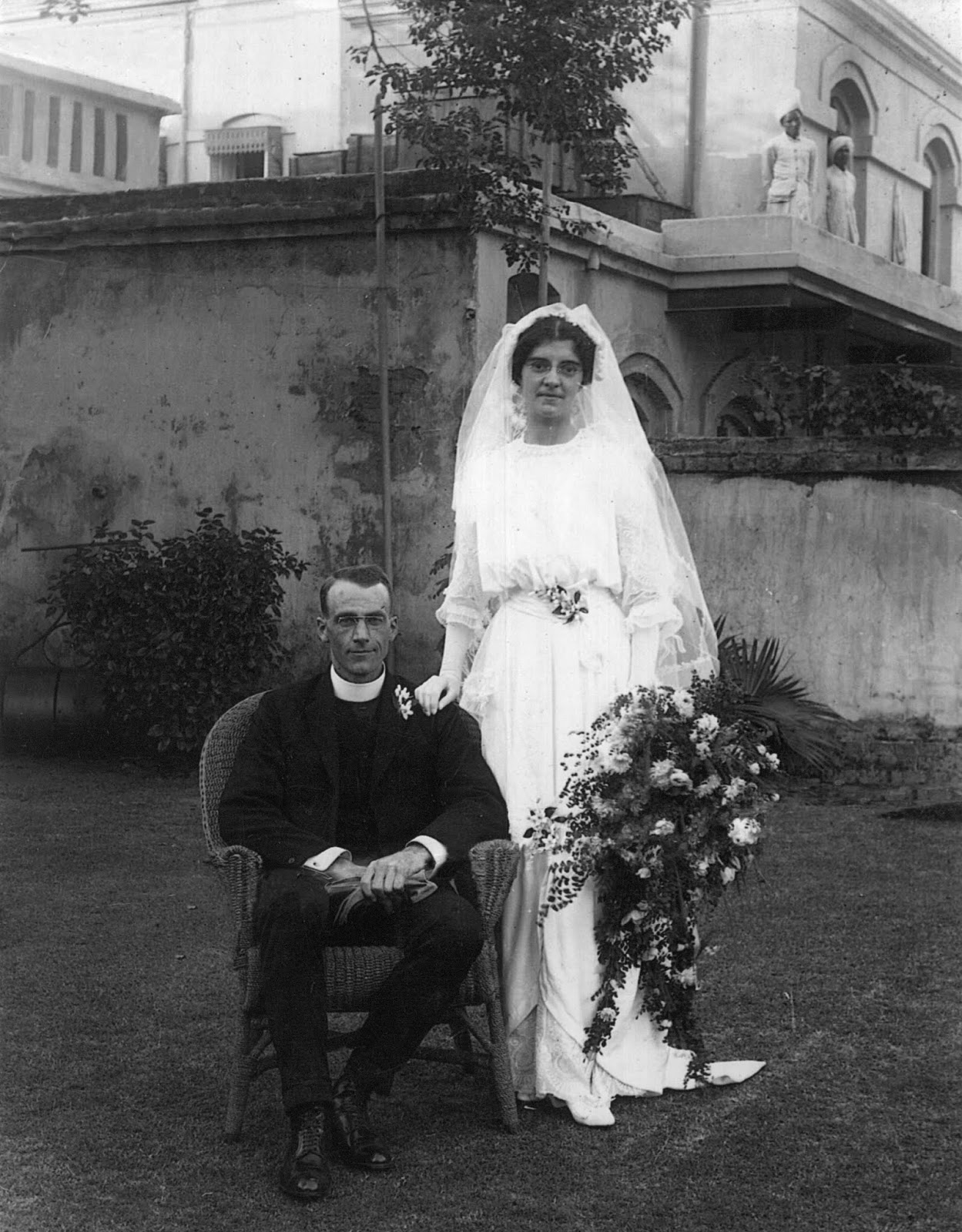
Above: Frank Paice and Florence Cox pictured after their wedding in Calcutta
    The astonishment that greeted this devoutly Christian couple's divorce was matched decades later by the evasiveness shown by Richardson's mother in 1997 as the journalist asked after 'Great Aunt Florrie'. 
    "The first thing my mother said when I asked about Florrie was, 'Oh we don't talk about her'.  She became visibly embarrassed and evasive", Richardson says.
    "I'd been a journalist for all these years so I wouldn't let it go.  I pressed and pressed and she said that Aunty florrie had been a missionary around the first World War and had married a missionary as well. 
    "And during that marriage, her husband had become involved with another woman who was also a missionary.  I was only a little girl and no one talked about it.  Initially I thought it was an interesting sidebar story.  But what I found out was astonishing".
    Whilst divorce among missionaries, in a largely conservative world was more than just unusual, the fact that the divorce had then been kept a secret was even more intriguing, a fact merely exacerbated by a mysterious illness that, Richardson would later find out, had afflicted Florrie: a condition that had had a direct impact on the marriage and one which would later lead to Florrie being ostracized by her family and community.
    "The first point for me was that no one had talked about the divorce there was no information about it", Richardson continues.
    "When I approached the Supreme Court of Victoria about it, they would not show me the file, which was quite remarkable.  I thought it was very odd and they were quite adamant that they not give me the file because they said that the judge at the time of the divorce had ordered for the file to be closed for all time.  Well that really did get me curious."
    The resolute Richardson pressed on.
    "The battle with the Supreme Court was a long one but the people in charge understood why I wanted the information and I think they sympathized with it.  It was a piece of Australian history and church history.  I nagged them and nagged them over several years until they got so fed up with me and said I could make an application to the Supreme Court. 
    "To my astonishment, the judge approved the application."
    The file would start a remarkable hunt. 
    When Frank and Olga's affair became known, both were forced to resign. 
Florrie, too, returned to Melbourne and found that she was suffering from a very rare gender condition which may have impacted on her marriage. After the divorce, Frank and Olga went to Calcutta where they were married in a discreet civil ceremony. 
    "Florrie never knew what was wrong with her.  She grew up in a very religious Protestant family in an age when sex was a totally taboo subject.  The first Florrie knew that something was wrong was on her honeymoon when she and her husband were unable to have intercourse.      The marriage never recovered from that. 
    "Florrie went to her grave in 1950 thinking she was some form of freak, getting little support from her embarrassed family or from the equally-embarrassed Baptist Church in Australia. Her actual condition was not given a name until after she died."
    Remarkably, the press was also told to ignore the whole affair and the file on the divorce ordered by a judge to be closed for all time.
    Florrie was shunned by her family who failed to understand the burden she had faced and following the general norm to blame the woman for the breakdown of the marriage. 
Frank and Olga in the meantime had returned to Bengal for different work - Frank had taken up an engineering management job - before returning to Australia as upstanding members of the community.
Above: Councillor Frank Paice and Olga later in life.
    In Australia that standing would reach phenomenal heights: the couple becoming regular fixtures in the social scene in their town and becoming prominent in civic society. 
The past was buried.  No mention was ever made of their time in India and, in particular, Frank's first marriage.  Not even their only son and close friends knew of their missionary past.
    'God's Triangle' is made up of a series of diary entries as Richardson travels to Calcutta and Bangladesh. 
    His curiosity and journalistic skill shines through as he trawls through myriad troves of documents. 
    During his research, Richardson also discovers that Frank and Olga had a son, Paul, who aids in Richardson's search, astonished at the double life his parents lived.
    The cover up is arguably the biggest aspect of the story.  How was it accomplished and who ordered it covered up?
    "This is a story that had everything.  It was scandalous.  How did Olga and Frank hide their past?  I think that was amazing.  I mean they were so prominent in suburban Melbourne society.  How did they manage to get away with people not asking about six missing years in their lives? 
    "Above all though, it was a cover up."
    Richardson suggests that the Baptist church - aided by the ever-present freemasons - went to elaborate lengths to sweep things under the carpet. 
    Despite its diary-like style, the book is gripping, not least due to Richardson's meticulous attention to the tiniest details. 
    At just over 150 pages long, it's not a big book by any means but it is crammed with information, shedding light on everything from the religiously conservative community that all three main characters hailed from to the remote part of East Bengal where carried out their extraordinary work.
    It's a book about religion and the dichotomy of the yeomen missionary work carried out by the likes of Frank, Florrie and Olga and the all-pervasive power of a church with medieval ideas about sexuality and personal freedoms.
    Above all, it's a book about tolerance and justice for a woman who was unfairly marginalized for a reason that those were doing the marginalizing had little understanding about: a problem that continues to blight humanity.
    Unsurprisingly, a story with such universal themes has caught the attention of a number of filmmakers.
    West London-based Richardson is in the final stages of scripting a multi-million dollar film project based on 'God's Triangle'. 


For more information, visit www.godstriangle.com

Sunday, 24 August 2014

Funerals: a reason to be cheerful?

A week ago, I went to a funeral in London of a friend and former BBC colleague. He was a Roman Catholic, although I don't recall him displaying much enthusiasm for the church. This was reflected in the service which seemed to me to be more secular than religious. But as I have never been to a Catholic funeral before, I am not able to judge with any authority.

What did strike me about the 200+ mourners was that at least 95% wore dark clothes and I was one of the few men who did not wear a tie.

How different this is to many of the funerals that now take place in Australia, the land of my birth. It is quite common there for mourners to wear casual clothes. In some cases, mourners are invited to "wear something bright" to reflect that the event is a celebration of the deceased's life.

When my mother died, Rena M. Wood, aged 95 in Melbourne in 2007, the large turnout of mourners wore a variety of clothes from dark suits and ties to bright casual, tie-less outfits. It was, on the whole, a cheerful occasion with a good sprinkling of admiration and amusing anecdotes and laughter. My mother had not died of anything in particular, but of old age. In her advanced years, she was consistently upbeat about her life and achievements and declared herself "ready to go", whenever that might be.

My mother's funeral was so different from the one I attended for my former colleague. He had died at the early age of 61 after a very long battle with cancer. So, although the event was a celebration of his colourful and entertaining life and achievements, it was also a time of enormous sadness because the cancer had devastated his family and cut short his broadcasting career.

There was another big difference between the two funerals: Both my mother's private cremation service and the thanksgiving service later in the day were filmed. Crematoriums and many funeral chapels in Australia routinely video services and offer a DVD copy to the family. Some families take up the offer; others do not. It is left entirely to them.

Although I had seen my mother about a week before her death, I was back in London by the time she died, but a friend who has a TV production company in Melbourne happily agreed to send a two-camera crew to film the service. None of the mourners objected or even raised an eyebrow of disapproval, as far as I could tell.

The raw video from the two cameras was sent to me in London where I edited it into a complete record of the service. By the time I had completed this, I almost felt that I had been there. Members of my immediate family were very happy to get the finished DVDs for their family history files.

When I told an English friend about the filming, she bluntly declared it to be "weird". She said she would never want to watch a recording of her parents' funerals. She didn't get on with either parent so she wouldn't wish to be reminded of what might of been had she not had such a dysfunctional relationship with them.  I didn't always get on with my mother, but she was an extraordinary woman of generosity and with a vividly-amusing streak of eccentricity. And, of course, she was "ready to go".

As I am on the subject of funerals, let me also tell you about one that came with an emotional punch at the end. It was an austere non-religious event with no singing -- just eulogies from the deceased woman's daughter and two sons. The contributions from the daughter and one of the sons were heartfelt, but not at all controversial. Not so the speech by the other son. He took the opportunity to reveal the extended abuse his mother has suffered from her father. He went so far as to suggest that she had lost one of her babies as a result of an unprovoked beating. Furthermore, he denounced a Catholic priest who had been involved with the family. It was, without exaggeration, jaw-dropping stuff. Neither of the other siblings was aware that this was coming, but they seemed not to be offended. They felt their brother had a right to get it all off his chest, which he most certainly did.

UPDATE: My brother, Jeffrey A. Richardson, died in Australia in March this year (2020). Because of covid-19 travel restrictions, neither I nor my younger sister living in New Zealand could attend the funeral service. There was also a limit of no more than 10 people allowed to be present at the service. However, those family and friends living in the United Kingdom, New Zealand and around Australia were still able to witness the service as it was live streamed by the funeral company. Additionally, a recording of the ceremony was made available on the company's website for a month. An excellent service that is likely to become more widespread.

Finally, if you would like to learn more about my mother's memorable life, click here: Rena's obituaries.

Tuesday, 8 July 2014

Why was this photo an embarrassment?


As a keen genealogist I have many family photographs that I would regard as “special”, but this is one that I wasn’t supposed to see. Nor were any other descendants of the couple who are pictured. The couple were my great aunt, Florence “Florrie” Cox, and the Rev. Frank E. Paice, on the day they were married in Calcutta (now Kolkata) in December 1914.

Both were Baptist missionaries from Australia, stationed in the early 1900s in East Bengal, now Bangladesh. The marriage fell apart in scandal for two reasons: 1) Frank Paice had fallen for another missionary, Olga Johnston, during the two-year engagement that the church required Florrie and Frank to spend apart. 2) Florrie had a rare variation of the intersex condition, Androgen Insensitivity Syndrome. Although she looked and felt like a woman, she had male chromosomes and could not function in several important respects as a female.

When Frank and Olga’s scandalous affair became known, both were forced to resign. Florrie returned to Melbourne, but was a family embarrassment with the breakdown of her marriage a relentlessly taboo subject.

The Australian press – normally addicted to such juicy stories – was prevailed upon to look the other way when the divorce went through the Supreme Court and the judge ordered that the file be “closed for all time”.

Frank and Olga married on their return to Bengal where Frank took up an engineering management job. When they returned to Australia some years later, they had reinvented themselves as pillars of society, with Frank taking on a number of high-profile civic positions in Melbourne. No mention was ever made of Frank or Olga’s time in India or their six years as missionaries. Not even their only son and close friends knew of their missionary past. I learned of the scandal only because my mother let it slip when we came across a photograph taken just before Florrie was about to depart for her wedding in Calcutta. 


It took me 18 months of email exchanges, letters and telephone calls to get a Supreme Court judge in Melbourne to lift the ban on access to the divorce file, revealing Florrie’s condition. But nowhere could I find photographs of Frank and Florrie’s wedding as they had been destroyed by the family – probably out of embarrassment and anger. Then I got lucky. A very distant cousin showed me a photograph of two people he could not identify. I was stunned to see that it was Frank and Florrie after their wedding at the Circular Road Baptist Chapel, Calcutta. Somehow it had survived the family's photographic purge and my hunt was over.

The story of Florrie Cox and Frank Paice is told in my book God’s Triangle, available in paperback and ebook.

Finally, an unresolved question:
Why is Frank seated while Florrie stands? I have part of the answer. Florrie would have wanted to show off her frock and her large bouquet to their best effect. However, it was unusual, but not unknown, for the groom to be seated for a wedding portrait.  I am unable to track down any reliable explanation why Frank chose to sit down, but maybe it was because Frank was shorter than Florrie.