Showing posts with label Bangladesh. Show all posts

Tuesday, 8 September 2020

The sad and troubled life of Florence "Florrie" M. Cox

An extract from God's Triangle, my investigation into what happened to Florence Martha "Florrie" Cox of Melbourne, Australia, after she married the Baptist missionary, the Revd Frank Ernest Paice, who was born in Christchurch, New Zealand, but was brought up in Australia:

Florence Martha “Florrie” Cox (later Paice) 1887-1950 

Florrie Cox was born at home in the Melbourne suburb of Richmond on November 5, 1887, the third of six children born to Arthur and Amelia Cox. It was a very religious family—extremely so in the case of some members. 

Amelia was very strict, with church-going, hymns, prayers and reading the bible being the only activities permitted on Sundays. Even the meals were prepared the day before. There were complaints in the family about the time Amelia devoted to church activities, often to the detriment to her perceived responsibilities as a mother and housewife. It was as though she were acquiring credit points to ensure her place in Heaven. 

I have not been able to learn anything significant about Florrie’s father, Arthur, as he had died before any of his surviving descendants were old enough to absorb impressions of him. 

Florrie had two brothers, Arthur and Charles. Her sisters were, in order of birth, Amelia (known as “Minnie”, perhaps to differentiate her from her mother), Alice and Lois. 

The two brothers could hardly have been less alike. Arthur was my grandfather and was a forceful, intolerant, humourless, status-conscious, hypocritical and sometimes-violent man with few friends. His religious fervour led him into several bouts of insanity that required hospital treatment. During the Second World War, he was diagnosed with religious mania and dismissed as a major in the Australian Army after declaring to his men that he was Jesus Christ’s second-in-command. 

By contrast, his younger brother Charles—universally known as “Charlie”—was a polite and placid businessman who never forced his views on anyone. He had no interest in religion and attended church very rarely and only when pushed to do so by his wife. By all accounts, he was widely liked and admired. 

Florrie Cox’s sisters, Minnie and Alice, were both married with children, while her sister Lois battled tuberculosis throughout her teenage years before dying when just 22. Little else is known of the three sisters, nor has it been possible to establish exactly what Florrie Cox was like in her early years. She was, though, sufficiently religious to become a Sunday School teacher and later to take on the considerable burdens of a missionary wife in one of the more arduous and remote postings the Baptist Church could offer. 

Florrie was unusually tall for a woman in that era—about six feet or 183cms. She became engaged to Frank Paice when she was 24, which would have been considered rather late. In those days, women who weren’t “fixed up” to be married by their early twenties were usually fearful of being left “on the shelf”, and as spinsters, were often viewed as unfulfilled persons. 

On the other hand, men who did not marry would be referred to, often with affection and respect, as “confirmed bachelors”. The strong possibility that many of these men were closet homosexuals did not seem to be considered. 

In the light of what we know about Florrie’s mother and other conservative members of that family, there must have been great joy that she was to be married—and not just married to anyone, but married to a Man of God and a missionary. 

There is no precise record of when Frank and Florrie were engaged, but the indications are that it was not long before Frank sailed for India in October, 1912. 

Though society contained pockets of uninhibited licentiousness in the early 1900s, sexual attitudes for most people—particularly staunch Christians—were very rigid and oppressive. Married women could expect to have many pregnancies in their reproductive life, but they would be told little about the “facts of life”, as sexual knowledge was euphemistically called. 

The more liberal-minded families might offer a newly-married woman a book on “married women’s health”. These books touched on reproductive matters, but were usually very coy and often ill-informed. (One such book included the “fact” that the best way to avoid pregnancies was to engage in conjugal relations midway between the monthly periods.) 

It was widely felt that wives should simply follow the lead of their husbands in the marital bed, though in the majority of cases, their husbands were almost as anxious and sexually ignorant as their wives. The only truly effective form of contraception was abstinence. This was not seen by devout Christian women as a burden, as it was considered very unladylike to enjoy sex, or at least to admit to enjoying it. 

I remember overhearing elderly female relatives declaring that it was important for married women to “maintain Christian standards in the bedroom”. I took this to mean that any sexual activity should be confined to the so-called “missionary position” with the man always on top in the traditional manner. 

These standards would also require that any nudity be as discreet as possible. (One of my Cox family aunts once proudly declared that her husband had never seen her naked.) 

The accepted attitude of married women towards sex—not helped by the fear of yet another pregnancy—often had a discouraging impact on their husbands. Even in my youth in the 1950s, it was quite common for married men to scornfully dismiss sex as “an over-rated indoor sport”. 

To avoid being carried away by sexual desires, courting couples in the early 1900s were normally not allowed to be alone together until such time as they became engaged. When they went out together on a date, they would be required to do so with a chaperone. 

Keeping this in mind, Florrie and Frank would have had few opportunities for sexual encounters before Frank left Australia. Even when Florrie joined him in Calcutta two years later, she and her fiancĂ© would have been allowed little or no time together. Nor, as devout Christians, would they have wanted it any other way. 

If the social and sexual climate had been more relaxed—dare I say, enlightened—it is quite possible that the marriage between Frank and Florrie would never have taken place. However, given their status in the community and the laws of that time, breaking off an engagement was almost as difficult as a divorce is today. One or other of the parties could have sued for “breach of promise”. This was something not treated lightly by the courts and often ended up with public humiliation in the newspapers and the payment of financial compensation by the offending party. 

++++++++++++++++++++++

Paperback, Kindle and eBook copies of God's Triangle are available HERE.  

Read the reviews HERE.

Saturday, 30 November 2019

A special photograph that escaped being destroyed

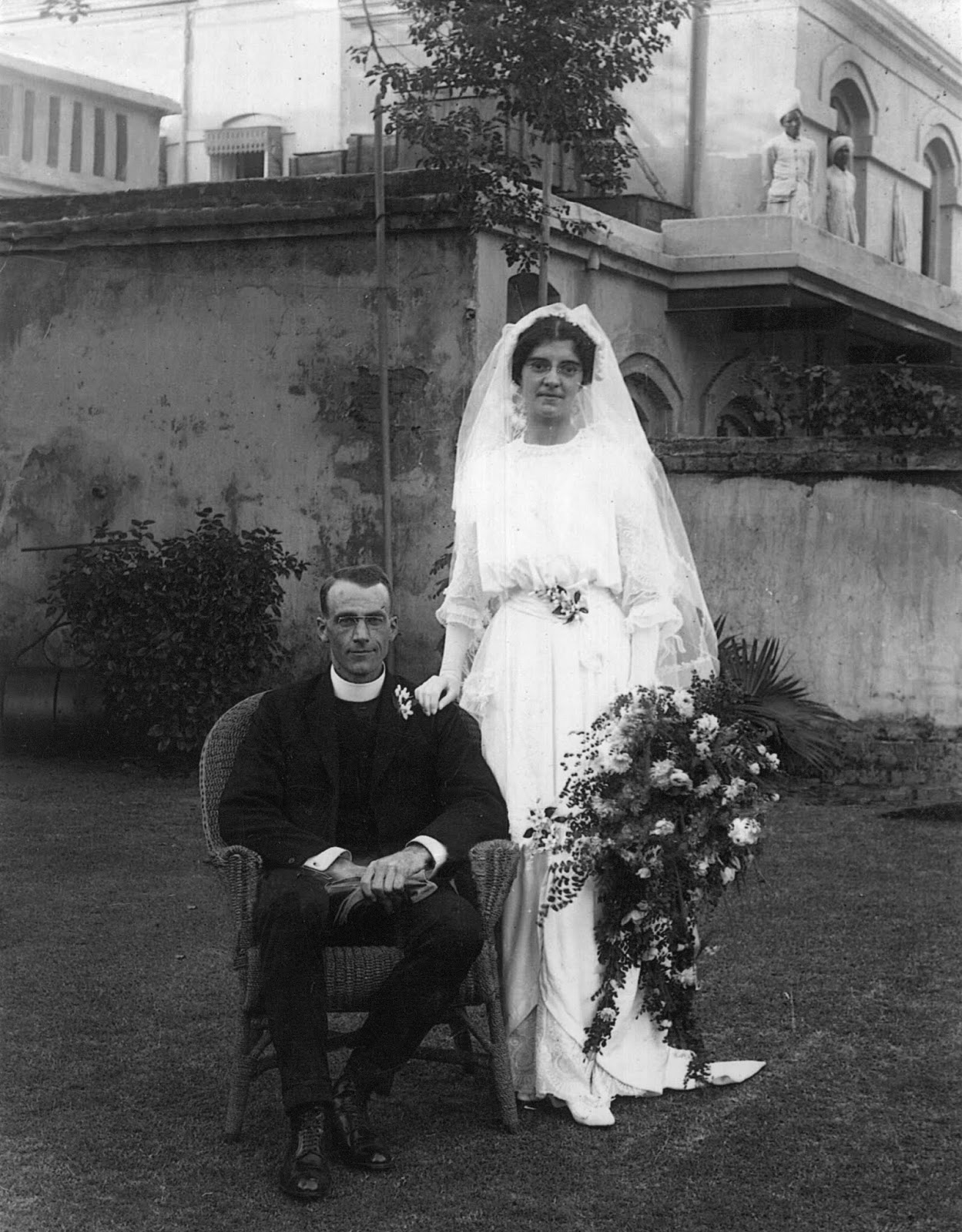
     As a keen genealogist I have many family photographs that I would regard as “special”, but this is one that I wasn’t supposed to see. Nor were any other descendants of the couple who are pictured.  

      The couple were my great aunt, Florence “Florrie” Cox, and the Rev. Frank E. Paice, on the day they were married in Calcutta (now Kolkata) in December 1914. 


Both Frank Paice and Florrie Cox were Baptist missionaries from Melbourne, Australia, stationed in the early 1900s in East Bengal, now Bangladesh.  

Their marriage fell apart in scandal for two primary reasons: 1) Frank Paice had fallen for another missionary, Olga Johnston, during the two-year engagement that the church required Florrie and Frank to spend apart. 2) Florrie had a rare variation of the intersex condition, Androgen Insensitivity Syndrome. Although she looked and felt like a woman, she had male chromosomes and no internal female organs. 

When Frank and Olga’s scandalous affair became known, both were forced to resign.  Florrie returned to Melbourne, but was a family embarrassment with the breakdown of her marriage a relentlessly taboo subject.  

The Australian press – normally addicted to such juicy stories – was prevailed upon to look the other way when the divorce went through the Supreme Court and the judge ordered that the file be “closed for all time”.  

Frank and Olga married on their return to Bengal where Frank took up an engineering management job. 

When they returned to Australia some years later, they reinvented themselves as pillars of society, with Frank taking on a number of high-profile civic positions in Melbourne.  No mention was ever made of Frank or Olga’s time in India or their six years as missionaries. Not even their only son and close friends knew of their missionary past. 

I learned of the scandal only because my mother let it slip when we came across a photograph taken just before Florrie was about to depart for her wedding in Calcutta. 


It took me 18 months of email exchanges, letters and telephone calls to get a Supreme Court judge in Melbourne to lift the ban on access to the divorce file, revealing Florrie’s condition. But nowhere could I find photographs of Frank and Florrie’s wedding as they had been destroyed by the family – probably out of embarrassment and anger 
      
Then I got lucky.  
      
A very distant cousin showed me a photograph of two people he could not identify. I was stunned to see that it was Frank and Florrie after their wedding at the Circular Road Baptist Chapel, Calcutta.  
      
My hunt was over thanks to a large dollop of luck, and the fact that the distant cousin's family had never been told about the scandal and didn't realise the photo's significance.  

The story of Florrie Cox and Frank Paice is told in Ian D. Richardson’s book God’s Triangle, available in paperback, Kindle via Amazon. 

Sunday, 17 December 2017

Talking to Bangladeshi Television


A very enjoyable chat the other night on Bengladesh television network NTV Europe with Talking Point anchor Syed Neaz Ahmad. Also enjoyable to meet network Chief Executive Officer Subrina Hossain and her very friendly team.

Neaz and I spent time discussing my book God's Triangle, which recounts the sad and true story of Australian Baptist missionary, Florence M. "Florrie" Cox, who was stationed in Calcutta, Mymensingh and Faridpur during the First World War.


We also chatted about my thriller The Mortal Maze, a morality story about a BBC correspondent in the Middle East and trapped into becoming a spy. Neaz was keen to know how my time with the BBC had shaped this story. The answer is "a great deal".


Another subject was my progression into print then broadcast journalism as a youth in my home country, Australia, before spending 27 years with BBC World Service radio and television in London.

For anyone interesting in the Talking Point discussion, click here: Part One  Part Two 
Part Three 

Read about Ian Richardson's visit to Bangladesh to research God's Triangle. Click here: Bangladesh Diary

Tuesday, 1 November 2016

A PHOTOGRAPH THAT NO-ONE WAS SUPPOSED TO SEE


As a keen genealogist I have many family photographs that I regard as “special”, but this one is particularly so because I wasn’t supposed to see it. Nor were any other descendants of the bride and groom.
      The couple were my great aunt, Florence “Florrie” Cox, and the Rev. Frank E. Paice, on the day they were married in the Circular Road Baptist Chapel in Calcutta (now Kolkata) in December 1914. Both were Baptist missionaries from Melbourne, Australia, and went on to be stationed in East Bengal (now Bangladesh).
      The marriage, which began with high hopes in both families, fell apart in scandal. This was partly because Frank had developed a fondness for a fellow Australian missionary, Olga Johnson, but the greatest contributing factor was the discovery on the honeymoon that Florrie had no vagina.
      Florrie had what was identified after her death in 1950 as Androgen Insensitivity Syndrome (AIS). She looked and felt that she was a woman, but had male chromosomes and no internal female organs.
      The marriage took place in an age when sex was a taboo subject in strict Christian families. It was quite common for females never to be told in advance about menstruation. In Florrie’s case, she was never aware that mature women should be having periods. Nor did Frank know this until much later.
      In my years of research into why the marriage ended in a covered-up annulment divorce, I found few photographs of Florrie and no photographs of the wedding. That is, until I met a distant cousin who had been researching a different branch of the Cox family.
      The cousin showed me a postcard copy of the photo accompanying this article, but had no clue who was in it, other than the words “Florence and Frank 1914” written on the back. We came to the conclusion that this was probably the only copy in existence because all the others had been destroyed by the more immediate family members of Florrie and Frank.
      After the divorce went through in a secret session in the Supreme Court in Melbourne, Florrie led a quiet life, often battling depression, and regarded by her family as an embarrassment. Frank went back to India, married Olga, became a pillar of the engineering world in Calcutta, then returned to Melbourne years later to be prominent in local government. Both he and Olga died in the 1960s with very few people – not even their only child – knowing about the scandal or that they had ever been missionaries.
      One question that is frequently raised by those who see the wedding photograph: “Why is Frank sitting while Florrie stands?” One answer was that he didn’t want it to be obvious that he was shorter than his bride. But there are also suggestions that the photographer wanted the focus be on the bride, allowing her to display her wedding dress and her bouquet to their best advantage.

The investigation by Ian Richardson into what happened to
 Florrie Cox and Frank Paice is available from Amazon

Thursday, 18 September 2014

The story about, and the story behind, God's Triangle


GodsTriangle: A tale of love, loss and scandal in early 
20th Century East Bengal
From  UK Asian September 2014
    For the curious there's nothing quite like flipping through old family albums, delving into the past, exploring the stories of the men and women who went before.
    Ian Richardson is blessed with shiploads of that particular kind of curiosity.
    The former BBC journalist's curiosity was piqued no end one later winter's day in 1997 in his hometown of Melbourne, as he helped his recently-widowed mother sort through some old family photographs. 
    One photograph in particular caught Richardson's attention, one that would culminate, some fifteen years later, in 'God's Triangle', an extraordinary story about sexual and religious politics, cover ups and nefarious intrigues in early 20th century Australia and India. 
Florence Cox (Standing 2nd from Left)
    At the heart of this fascinating story are three even more fascinating characters, all Australian missionaries: Florence Cox, Richardson's great aunt, who was affectionately known as 'Florrie'; her husband the Reverend Frank Paice and Olga Johnston, one of the bridesmaids at Florrie and Frank's wedding.
    In October 1912, Frank Paice left Melbourne for East to join the scores of Baptist missionaries who were attempting to spread the word of god in the then-wilds of what would become Bangladesh.
    When not preaching, the missionaries were doing yeomen work in some of the sub-continent's poorest and most deprived communities.
    Frank had recently become engaged to Florrie, then aged 24. 
    Florrie had a certain languidness to her, unusually tall in comparison to her contemporaries and devoted to her work. 
    She would join her new husband in Calcutta, some two years later. 
    Their marriage however, endured - for a lack of a better word - in the malarial swamps of the Bengal, culminating in a scandalous divorce after five years: scandalous for numerous reasons. 
Above: Frank Paice and Florence Cox pictured after their wedding in Calcutta
    The astonishment that greeted this devoutly Christian couple's divorce was matched decades later by the evasiveness shown by Richardson's mother in 1997 as the journalist asked after 'Great Aunt Florrie'. 
    "The first thing my mother said when I asked about Florrie was, 'Oh we don't talk about her'.  She became visibly embarrassed and evasive", Richardson says.
    "I'd been a journalist for all these years so I wouldn't let it go.  I pressed and pressed and she said that Aunty florrie had been a missionary around the first World War and had married a missionary as well. 
    "And during that marriage, her husband had become involved with another woman who was also a missionary.  I was only a little girl and no one talked about it.  Initially I thought it was an interesting sidebar story.  But what I found out was astonishing".
    Whilst divorce among missionaries, in a largely conservative world was more than just unusual, the fact that the divorce had then been kept a secret was even more intriguing, a fact merely exacerbated by a mysterious illness that, Richardson would later find out, had afflicted Florrie: a condition that had had a direct impact on the marriage and one which would later lead to Florrie being ostracized by her family and community.
    "The first point for me was that no one had talked about the divorce there was no information about it", Richardson continues.
    "When I approached the Supreme Court of Victoria about it, they would not show me the file, which was quite remarkable.  I thought it was very odd and they were quite adamant that they not give me the file because they said that the judge at the time of the divorce had ordered for the file to be closed for all time.  Well that really did get me curious."
    The resolute Richardson pressed on.
    "The battle with the Supreme Court was a long one but the people in charge understood why I wanted the information and I think they sympathized with it.  It was a piece of Australian history and church history.  I nagged them and nagged them over several years until they got so fed up with me and said I could make an application to the Supreme Court. 
    "To my astonishment, the judge approved the application."
    The file would start a remarkable hunt. 
    When Frank and Olga's affair became known, both were forced to resign. 
Florrie, too, returned to Melbourne and found that she was suffering from a very rare gender condition which may have impacted on her marriage. After the divorce, Frank and Olga went to Calcutta where they were married in a discreet civil ceremony. 
    "Florrie never knew what was wrong with her.  She grew up in a very religious Protestant family in an age when sex was a totally taboo subject.  The first Florrie knew that something was wrong was on her honeymoon when she and her husband were unable to have intercourse.      The marriage never recovered from that. 
    "Florrie went to her grave in 1950 thinking she was some form of freak, getting little support from her embarrassed family or from the equally-embarrassed Baptist Church in Australia. Her actual condition was not given a name until after she died."
    Remarkably, the press was also told to ignore the whole affair and the file on the divorce ordered by a judge to be closed for all time.
    Florrie was shunned by her family who failed to understand the burden she had faced and following the general norm to blame the woman for the breakdown of the marriage. 
Frank and Olga in the meantime had returned to Bengal for different work - Frank had taken up an engineering management job - before returning to Australia as upstanding members of the community.
Above: Councillor Frank Paice and Olga later in life.
    In Australia that standing would reach phenomenal heights: the couple becoming regular fixtures in the social scene in their town and becoming prominent in civic society. 
The past was buried.  No mention was ever made of their time in India and, in particular, Frank's first marriage.  Not even their only son and close friends knew of their missionary past.
    'God's Triangle' is made up of a series of diary entries as Richardson travels to Calcutta and Bangladesh. 
    His curiosity and journalistic skill shines through as he trawls through myriad troves of documents. 
    During his research, Richardson also discovers that Frank and Olga had a son, Paul, who aids in Richardson's search, astonished at the double life his parents lived.
    The cover up is arguably the biggest aspect of the story.  How was it accomplished and who ordered it covered up?
    "This is a story that had everything.  It was scandalous.  How did Olga and Frank hide their past?  I think that was amazing.  I mean they were so prominent in suburban Melbourne society.  How did they manage to get away with people not asking about six missing years in their lives? 
    "Above all though, it was a cover up."
    Richardson suggests that the Baptist church - aided by the ever-present freemasons - went to elaborate lengths to sweep things under the carpet. 
    Despite its diary-like style, the book is gripping, not least due to Richardson's meticulous attention to the tiniest details. 
    At just over 150 pages long, it's not a big book by any means but it is crammed with information, shedding light on everything from the religiously conservative community that all three main characters hailed from to the remote part of East Bengal where carried out their extraordinary work.
    It's a book about religion and the dichotomy of the yeomen missionary work carried out by the likes of Frank, Florrie and Olga and the all-pervasive power of a church with medieval ideas about sexuality and personal freedoms.
    Above all, it's a book about tolerance and justice for a woman who was unfairly marginalized for a reason that those were doing the marginalizing had little understanding about: a problem that continues to blight humanity.
    Unsurprisingly, a story with such universal themes has caught the attention of a number of filmmakers.
    West London-based Richardson is in the final stages of scripting a multi-million dollar film project based on 'God's Triangle'. 


For more information, visit www.godstriangle.com

Saturday, 12 April 2014

What comes first -- the book or the film of the book?

UPDATE: Since posting the message below I have received very useful suggestions about the need to make my book less like a film script. In view of this, I have made several changes (see the link towards the bottom of the page). Feel free to make any other suggestions that you feel might improve the telling of the story. Ian R
-----------------------------------------------------------------

As much as there are any hard and fast rules in the film-making business, it is the received wisdom that a book is written then someone else buys the film rights and turns it into a movie.

That's not the way it is with me, but then perhaps I am just perverse.

To be honest, I had never intended to become a screenwriter -- certainly not one so late in life after more than 40 years in print and broadcast journalism in Australia and the United Kingdom. Nor had it ever occurred to me that I might write a book. Quite the contrary. I always thought a book would require too much damned effort. But here I am, both screenwriter and book author and doing things in what many professionals think is the wrong way around.

But to go back a bit...

My first screenplay, GOD'S TRIANGLE, came about by accident. My wife, Rosemary, and I are keen genealogists and stumbled across the fascinating and sad story of my Australian Great Aunt Florence "Florrie" Cox. Florrie was a Baptist missionary in East Bengal (now Bangladesh) during the First World War, and as the story emerged of why her marriage to the Rev. Frank E. Paice went into meltdown, Rosemary recognised its potential as a feature film.

I sold the idea to an official of  Film Victoria, the Victorian State Government film agency in Melbourne. But pitching an idea to someone who thinks it is a great idea is the easy bit. In my case, I also naively believed that a total of seven years in television news qualified me to write the script for a film lasting between 90 and 120 minutes. Wrong. So wrong. My first attempt at a script was truly terrible, chiefly because it was dialogue driven and gave away too much information too early. Gradually I got the hang of screenwriting, but still no-one came forward with a firm offer.

The turning point came when Rosemary pointed out that I should be drawing up a detailed chronological account of our God's Triangle research for the historical record. This soon morphed into diary that became a paperback and ebook. And that did the trick. Once that was published, the interest grew and the film rights were picked up. The screenplay is now in pre-production development with two producers in Melbourne, financed by Film Victoria.

This got me thinking about my three other screenplays -- in particular The Moral Maze, a fictional thriller about a foreign correspondent corrupted by the intelligence services with disastrous consequences. Why not also write the book version of this story, I wondered? And that's what I am now doing, in the hope that its publication will lead to the screenplay being picked up by someone with access to about $US10m.

The book should be published before next Christmas. I'm just loving writing it because it requires such a difference approach to a film script. If you interested in making the comparisons, I have posted the opening scenes and chapters on my main Richardson Media Limited website. Here are the LINKS to the SCREENPLAY and to the BOOK.

Feel free to send me your comments to me: ian*at*richardsonmedia.co.uk

PS: Sorry that I can't give you a link to any extracts of the God's Triangle screenplay at this stage, but the script is again a work in progress and currently subject to commercial confidentiality.