Thursday, 10 August 2023

Moscow in the Gorbachev era

I recently came across these reports of my three BBC World Service work visits to Moscow in 1988 for the summit meeting between Mikhail Gorbachev, president of the Soviet Union, and Ronald Reagan, president of the United States. At the time I was the World Service News Intake Co-ordinator (in plain English, newsgathering team leader). It was my job to make things happen while the clever stuff was done by the broadcasters and producers. It is interesting to look back at a time in Moscow before Vladimir Putin.

Here's what I wrote back then and loaded onto my website: Gorbachev's USSR


Monday, 29 May 2023

Comments on my thriller

Some of the comments about my thriller set in the BBC in a fictional Middle Eastern country. Available as a paperback and Kindle ebook from Amazon. Click on reviews for easier reading:


Also available through Smashwords as an ebook.

Tuesday, 23 May 2023

Rolf Harris - my memories of him

The entertainer and convicted child abuser Rolf Harris has died. He was one of the most recognisable performers on British TV but ended his career in disgrace after he was found guilty of the indecent assault of teenage girls. He was 93. A registrar at Maidenhead town hall, close to Harris’s family home in the Berkshire village of Bray in the UK, confirmed that the former entertainer died on 10 May of neck cancer and “frailty of old age”.

I got to know Harris a little in the 1970s when I provided showbiz items for Australian outlets such as the Macquarie Radio Network and TV Week magazine. My first meeting with him was on March 29, 1969, after which I wrote this account in a letter to my family:

Rosemary [my wife who helped with the audio recording] and I went to the Hippodrome Theatre for an interview with Rolf Harris who has just completed another TV series and who will shortly return to Australia for a holiday. He did quite a good, sometimes quite funny, interview, but we didn’t have much time to really judge him as a person because he was in a hell of a rush to start rehearsals for his final show. But I should hope his home is tidier than his dressing room. The dressing room looked quite imposing from the outside, what with its chrome plated door and embossed stars, but inside it was an absolute mess. Clothes, sheets of art paper and tins of paint were everywhere, and there was hardly room for us to sit down. We arrived as he was in the middle of cleaning his teeth. He spent a fruitless frothing-at-the-mouth search for a towel, but had to settle in desperation for a hankie. Such is the life of an international TV star!

I interviewed him several times at various locations or over the phone. I would described his manner as business-like rather than matey. There was never any indication of the dark side of his life in those meetings. I appear not to have made copies of the interviews before the tapes were airmailed to Australia. All that I have is this TV Week article, written under the pseudonym, Bruce Conway, that I was required to use for that magazine and which was based on conversations I had with him and his documentary producer:


Harris was involved in charities and I was phoned at home by him on Boxing Day in 1974 after Darwin had been devastated by Cyclone Tracy, wanting to know if there was someone he could contact about organising a concert to raise money for the victims of the storm. I can't remember if such an event took place. 

He was, for a time, an honorary vice chairman of the charity called Physically Handicapped and Able Bodied (PHAB). An immediate neighbour of ours was then PHAB's events organiser. She adored Harris almost as much as she did another vice chairman, Jimmy Savile. She died some years ago before the scandals surrounding Harris and Savile came into the open. She would have been horrified by the revelations, disbelieving even.

My wife had another connection with Harris. Back in the early 1960s, she was employed by the Bendigo Timber Company in the Australian gold mining city of Bendigo in the state of Victoria. Harris was touring Australia and engaged by the timber company to perform on their stand at the local agricultural show. He and the company were promoting Masonite board, made famous by Harris as his "wobble board" in his hit single, Tie Me Kangaroo Down Sport. At the time, Harris's career as an entertainer was just taking off in Australia and the UK. She clearly remembers his performance but doesn't think she met him.

It's extraordinary that Harris risked such a high-profile and successful career by engaging in such terrible sexual abuse. Worse, he showed no remorse.


Sunday, 23 April 2023

Barry Humphries -- the man I knew

The sad death of Barry Humphries.

I knew Barry a bit in the 1970s when I was providing showbiz articles and radio interviews for Australian outlets. It would be a terrible conceit to claim him as a friend but I did interview him several times -- once in a toilet which was the only quiet spot we would find in a theatre -- and he would sometimes chat to me on the phone to try out sayings for The Adventures of Barry McKenzie, his comic strip in Private Eye magazine. There was the famous "technicolour yawn" for drunken vomiting, then I remember for some reason him asking me what I thought of "Go stick your head up a dead bear's bum". I can't remember if that was used in the strip.

On more than one occasion, when Barry was busy, he answered the phone with Edna Everage's voice, claiming to be his secretary and promising that "Mr Humphries will phone you back as soon as he is free" which he always did. On reflection it is amazing that he gave me his private telephone number. Most celebrities I interviewed had to be contact through their agent or publicist.

CLICK HERE to listen to a mostly-serious radio interview that I did with him for Australia's Macquarie Network in 1970 as he was becoming well known in the United Kingdom.

And these are articles I did for TV Week (Australia). For (legitimate) reasons too complicated to explain here, my TV Week articles were published under the name "Bruce Conway".


On what would have been Barry Humphries' 90th birthday (February 17 2024), BBC Radio 4 broadcast a tribute to the comedian. It was my privilege to be asked to contribute to this program at the beginning and during it. CLICK HERE to listen to it.


Tuesday, 21 March 2023

Tabloid journalism: a satirical view

I found a long-lost professionally-recorded comedy sketch made when I was at the National Film School 20 years ago. It's my pisstake of down-market tabloid journalism. (Surely not true.) It was chosen as a training exercise by the head of the department for film and TV directors. The actors and camera men were all professionals. There were about 10 versions filmed, but I have edited them down to just two lasting a total of five minutes: https://youtu.be/VmI14S5cFek


Sunday, 1 January 2023

The future. Can it be predicted?

I have a friend who is a centenarian. We recently discussed the many technical and other developments that had become a normal part of our lives. Most had not been predicted when my friend was born in 1920. 

Just some of these:

+ Radio (once known as the Wireless)

+ Television

+ The Internet

+ Emails

+ Supersonic air travel

+ Nuclear power

+ CT and MRI medical scans

+ DNA analysis

There are many more that could be named, which takes me on to the next question: what will happen in the next 100 years? Scheduled space travel and colonising the moon is an easy one to predict, but what else? Almost certainly, there will be developments that we would not have considered possible today. After all, my friend would never have thought that he would be able to sit in front of a device watching live moving pictures from around the world. And in high definition colour. 

Whatever the future holds, I won't be around as a witness unless there medical developments are imminent that will allow me to live forever. Perhaps that will be a good thing because not all developments will be beneficial for the planet and those who inhabit it.

Monday, 5 September 2022

Family history triggers

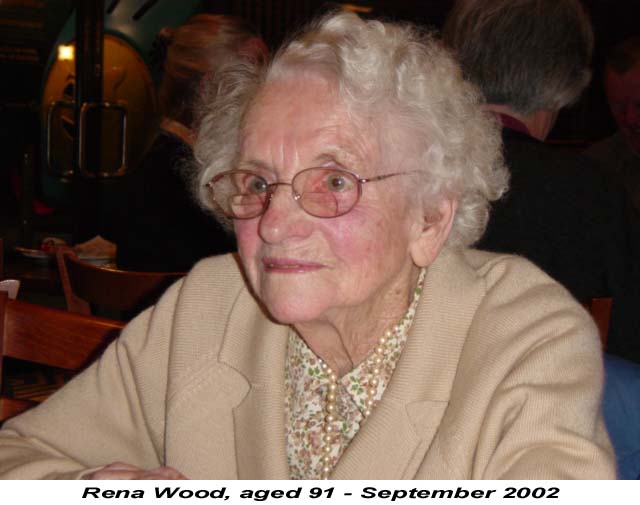
My mother, Rena Wood, formerly Richardson née Cox, spent her life in Australia and was a keen family historian. 

In her eighties she began Triggers, a collection of short accounts of events that had been significant in her life. They were written over a couple of years whenever something triggered a memory. It was a great idea and a wonderful alternative to the huge effort in writing and printing a book.

This is how my mother explained Triggers

How often I wonder, do we realize that small things such as noises, colours, words, pictures, smells, a chance remark from a friend or neighbour, even an item of news in the daily paper or magazines, something on TV or Radio recall to mind some event or incident, that happened in our childhood or in the years past? These things act as triggers to our memory and can be recalled when we have not thought about the experience or happenings for many years.

Here are some of her entries:

I recall, as a girl living in Melbourne, going to the city to see the procession of the Duke and Duchess of York through the city. The duke was then going to the Exhibition Building for some ceremony, but the duchess was returning to Government House and travelling in an open car down Spring Street. I was one of many children who ran halfway down Spring Street, wildly waving to the most gracious lady, now the Queen Mother.

Bad thunderstorms, bring to my mind our early fears, and how we would get into Mother's bed, or she into ours, to comfort us. Her way was to make us use our imaginations and describe to her what we thought it sounded like. A load of bricks falling down? The petrol tins? There were no petrol bowsers in my childhood, and the [four gallon] tins were piled high in the garage or shed and were being thrown about by the wind. Or would it be piles of crockery being dropped and broken? Rocks being dropped on glass or a window broken? It was not very long before we were imagining so many things, that the terror of the thunder and lightning had passed away.

 As a mother of four children, in a country town [Charlton, Victoria], my children dug trenches in the back yard, lined them with wheat and sugar bags, and with old blankets settled themselves down for the night. They had used sheets of galvanised roofing iron, to cover the trenches, to protect themselves from damp and rain, but not counted on the whippet dogs, owned by the next door neighbour, getting into our yard and walking over the iron sheets to investigate. From memory I think they survived out there until about 9pm, when they were happy to come inside to their own warm beds.

The T.V. pictures last year showing the great clouds of dust coming from the country to the city, clearly demonstrated to the city folk what all the words in the world failed to tell, of the problems of the early 1940s, when droughts for years at times caused the sun to be blacked out during the daytime. The worst [dust] storm I remember, the children were sent home from school [in Charlton] at lunch time, and by 2pm it was pitch dark, the street lights were put on, the fowls went to bed thinking it was night. Cars used their headlights and travelled slowly as it was impossible to see the shops on either side of the road.