I've just found an entertaining and informative recording of an interview I did with the Australian actor and broadcaster Ray Barrett back in December 1974. Ray, who gained international fame in the BBC TV series The Troubleshooters, spent much of his career also working in radio in both the United Kingdom and Australia.
In the interview, Ray talked about how different radio was between the two countries and what it was like being Tarzan and many other characters in Australian radio serials.
You'll find the interview HERE.
Ray returned to his home country in the 1970s and died of a brain haemorrhage on Queensland's Gold Coast in 2009.
Tuesday, 26 February 2019
Wednesday, 30 January 2019
What happened to Florrie Cox?
Florence Martha "Florrie" Cox and the newly-ordained Baptist missionary, the Rev. Frank E. Paice, became engaged to be married in 1912. There was much joy in the two families and at the church they both attended in Melbourne, Australia. But their honeymoon in Bengal, India, was a troubled occasion when they found it impossible to consummate the marriage for reasons neither could fully understand. So began the compelling saga of how the couple struggled to understand and cope with Florrie's condition, while fellow Baptist missionary Olga Johnston waited impatiently in the wings to snatch Frank away.
Why did the families and the church go to such lengths to hide what happened? And why did two Supreme Court judges in Melbourne order the divorce file to be sealed for all time? Ian D. Richardson, an Australian journalist who worked for many years for the BBC, was determined to learn the truth about his Great Aunt Florrie. God's Triangle is the result: a true story of revelation and betrayal.
Download the story here: https://www.godstriangle.com/ebook.html
Sunday, 20 January 2019
AUSTRALIA: a surprising and wonderful museum find
An Australian friend, the Bendigo artist Gail Tavener, recently tipped me off about printing equipment she had seen in a wonderful museum at Wedderburn, a small former gold mining town (population 680 at the last census) in the state of Victoria. As she remembered that I had once trained as a printer, she wondered if I knew anything about the machines, a Linotype type-setting machine and a Heidelberg automatic printing press. I not only knew about them, but once
worked on these exact machines.
(click on photographs to enlarge them, then Escape to go back to the story)
Back in 1961, I was employed by the Tribune weekly newspaper in
the neighbouring town of Charlton when my mother sold it to Ian and Coral
Cameron from Wedderburn. Ian's father had owned the Wedderburn Express but had sold it to a solicitor, Eric Shackleton "Shack" Bailey and
printer John Somerville. The Express had, since
its inception in the 1800s, been entirely handset, but "Shack" and John
modernised the operation by buying an Intertype (also known as a Linotype) and
a Heidelberg printing machine. Ian Cameron decided to loan me to the
Express for a few days each week to teach John Somerville how to use the
equipment.
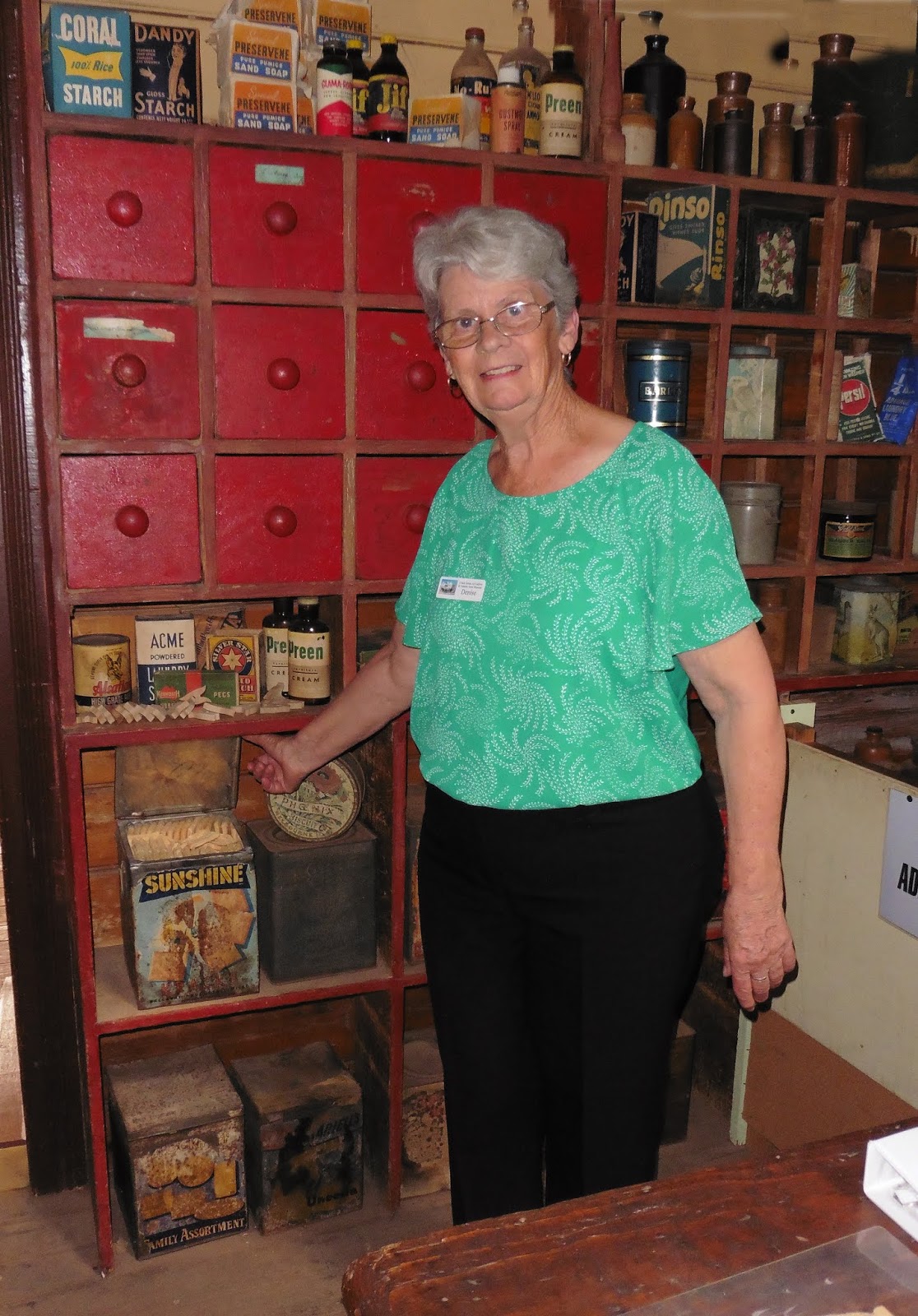
As I was on a visit to my homeland last month, I was able to call at the museum to be greeted by Denise Nichols
and her enthusiastic and friendly colleagues. It was a delight to be shown
around and reunited with the equipment that was part of my life so many decades
ago.
The Intertype/Linotype (above) and the Heidelberg (below)
The old type cases, and on the right is the roller that printed the proof sheets
,
Denise Nichols opens a tin of biscuits with the biscuits still intact, sort of, and below are some of the displays in the grocery shop that was frozen in time.
Finally, CLICK HERE for more details.
Sunday, 30 September 2018
A taste of a compelling thriller
Here's the start to the story...
CHAPTER
1
Jackson Dunbar – Jacko to his colleagues and friends –
surveys the scene before him with some disappointment. He has been in Armibar, capital
of Central Arabia, for a month now and he still hasn’t been able to get a report
on the BBC’s Ten O’Clock News.
It is a frustrating time for an
ambitious TV correspondent. Twice he has been to demonstrations in this shabby street,
pock-marked by bullets from a long-past battle, and in a part of the city well
away from the eyes of most citizens. On both occasions, a promised dramatic
event failed to make the grade, except for a few short clips on the World News
channel.
Jackson’s young Australian
cameraman, Pete Fox, is busy filming about 100 Arab men chanting and waving placards
calling for the destruction of Britain, America and Israel. Jackson stands to
one side making a few pencilled notes.
Jackson is 35, of medium height
and weight. His hair is dark but showing signs of thinning. His preferred work
wear is casual shoes, neat jeans and plain open-necked shirts. In summary, his
appearance is very ordinary. He is a person who would rarely attract attention
in the street, but he is gifted with an intuitive talent to project an image of
knowledge and authority when in front of a TV camera.
The demonstrators are mostly in grubby
traditional outfits, the ankle-length thawb or dishdash, and headwear, the keffiyeh. Women wearing black hijabs stand in the doorways ululating
and clapping.
It is very routine stuff,
unlikely to have any impact, and Jackson wonders why the demonstration is being
held in such an out-of-the-way run-down street with its dusty pot-holed roads,
broken pavements and heaps of stinking uncollected rubbish. Police and soldiers
in their cheap crumpled uniforms are there in substantial numbers as they
always are for demonstrations, but even they are looking upon the protest in a
way that suggests they wish they were back in their barracks playing cards or kicking
a football around the parade square.
Pete, in his late twenties and with
an accent and choice of clothes that make clear his Down Under origins, comes
over to Jackson: “Do you want to do a piece-to-camera, mate?”
Jackson takes another look
around him and shakes his head. “It’s another no-no. Let’s pack it in and get
back to the bureau.”
Pete is unsure. “I think I’ll stick
around a bit while they’re still here,” nodding towards the CNN and Al-Jazeera
crews and newsagency reporters.
“Please yourself, but my expenses
need urgent attention,” Jackson says with a grin.
He goes to the BBC’s silver Range
Rover 4x4 parked nearby and gets in beside the staff driver, Yassin Azizi, an
easy-going young Arab with a bushy dark moustache, wearing smart western
clothes and smoking a cigarette.
Five minutes later the car is
moving down an avenue alongside the Armibar Central Plaza, a busy and
prosperous air conditioned shopping mall with life going on as though the city is
at total peace with itself. It is a
world and a culture away from where they have just been. Many of the women are confidently wearing fashionable Western clothes
and proudly flaunting expensive designer handbags. Were it not for the many men
bustling about in their neat white thawbs and patterned keffiyehs, it could be any flourishing business centre in the developed
world.
Jackson spots a modern
glass-fronted bank and tells Yassin to pull over at the ATM. He inserts his card
and taps in the PIN. The card is rejected. Jackson angrily bangs the machine
with his fist and walks back to the car, watched with resignation by Yassin.
“Bloody banks!” mutters Jackson.
Yassin anticipates what will
happen next and already has his wallet out by the time Jackson gets back into
the passenger seat. He hands over a $50 note.
“Thanks,” says Jackson,
embarrassed that this is not the first time. “I’ll give it back when I get my
exes.” Yassin sighs but says nothing.
The car resumes the journey back
to the bureau. Jackson’s mobile phone rings. He sees on the screen that Pete is
calling. “Hi Pete!” There is no answer and the line goes dead. “Bloody phones,”
declares Jackson.
The car continues on its way,
both men remaining silent. Then, as they turn into the street lined with modern
brick office blocks where the bureau is situated, they spot the thirties-something
Anglo-Arab office manager, Samira Lang, at the front door. She simultaneously
sees the car and runs out onto the roadway, waving her hands furiously. Jackson
winds down his window. “Go back, go back,” Samira shouts. Jackson’s mobile
rings. It is Pete again.
“What’s the problem, Pete?” Jackson
listens briefly, then, “Okay. We’re on our way back now.” There is a Hollywood-style
squealing of tyres as Yassin does a fierce U-turn and speeds away.
Ten minutes later, Jackson is
back at the scene of the demonstration. It could not be more shockingly
different than when they left it such a short time ago. It is a blood bath.
Wounded and dead Arabs, both military and civilian, both male and female, are
lying in pools of blood on the road and in doorways. Soldiers are tensely lined
up, rifles raised and firing shots into the air, to keep back a gathering
crowd. There are sirens as police and military cars and ambulances arrive. Some
of the injured demonstrators are already in the back of private utility trucks
that charge away with headlights and horns blazing.
Jackson sees Pete filming from a
doorway and runs to him. Pete has blood running down his face. “What the fuck
happened?”
Pete replies while continuing
filming. “The demo was infiltrated by militants just before you left.”
“Did you see them?” Jackson
demands.
“I guess I did.”
“Well, why the fuck didn’t you
tell me?”
“How the hell was I to know they
were carrying hidden guns and grenades?! They just looked like regular
demonstrators who’d turned up late. Anyway, mate, don’t blame me for your own
failings. You shouldn’t have pissed off before you knew the story was really
over. You should know how sensitive everything is in this city.”
Jackson accepts that Pete is
right and that is how the acerbic bureau chief, Mack Galbraith, will also see
it. He knows he has to do something fast and drastic to salvage the situation. “C’mon.
Let’s not get into an argument, Pete, I need to know what you filmed?”
“Most of it, mate.”
“Thank Christ!” Jackson mutters.
Pete pauses to wipe the blood
from his face before adding caustically: “And thanks for asking how I am!”
“Sorry, Pete. What happened?”
“A ricochet off the wall just above
me when the troops opened fire on a guy who had appeared at a window with his
gun. It’s only a graze. I’ll be okay. But the guy at the window copped it.”
“Glad you weren’t badly hurt.”
Having expressed his concern,
even belatedly, Jackson is anxious to get back to the story. He nods towards
the CNN and Al Jazeera crews as they speed away. “How much did they get?”
“All of it, mate, and both Jane
and Omar were in the middle of doing their pieces-to-camera when it all blew
up.”
“Oh shit, shit, shit! Mack is
going to tear my balls off over this.”
Desperation is taking hold of Jackson.
“Look mate, I’ve really got to do a piece-to-camera.”
“That’s going to look a bit lame
at this stage, Jacko.”
“No it won’t. Run into that
derelict building over there, filming as you go, then turn the camera on me as
I run in after you.”
Pete hesitates. Jackson panics
as he sees his promising career coming apart before his eyes. “Do it, will you!
Just do as I say!”
The row begins to attract
bystanders, now that most of the wounded and bodies have been taken away. Pete
is embarrassed and runs without enthusiasm into the derelict building as
instructed.
Jackson pauses then races after Pete as though competing in a
100-metre sprint. Once inside, he crouches down, catches his breath and begins
pouring out words to the camera:
“What
started out today as a peaceful protest has turned violent. It…”
Jackson suddenly flinches and anxiously looks around before
resuming his report.
“Er.
It isn’t quite clear why the protest turned into such a savage confrontation,
but there are many dead and wounded. This bloody event is sure to place additional
pressure on the Central Arabian Government, which has been facing serious
allegations of corruption and a weakness towards what is seen as the imperial
ambitions of Israel and Western governments.”
Jackson flinches again, looks around anxiously, pauses a few
seconds, then casually stands up and dusts himself down. “That should do the
trick, Pete. Let’s get this back to the office.”
As they return to the 4x4, Jackson fails to notice a small
heap of human excrement just inside the entrance to the building. He steps
right into it. He screws up his face and wipes his shoe clean on a tuft of
grass. “You could be in the shit in more than one way,” laughs Pete.
There is more to read from this story by going HERE to Look Inside. And for some of the reviews, go HERE
Saturday, 11 August 2018
John S. Richardson and the R34 airship
John Smith Richardson was my paternal grandfather, He was born plain John Richardson in Lanarkshire, Scotland in 1880, but his grandmother's maiden name, Smith, was added later, giving him the same full name as his father. He was best known by his nicknames, Jock, Jake or Scotty. He married my grandmother, Elizabeth Mary "Bessie" McDearmid, in Glasgow in 1908, and they had two sons, my father, also named John Smith Richardson, and the younger Edward James "Ted" Richardson.
His proudest period was when he played a key roll in the construction of the famous R34 airship:
More on his interesting life can be found HERE
Tuesday, 31 July 2018
Why readers enjoyed this thriller
The author brings his Australian cultural
background and his professional life as a journalist into this brilliant read.
The characters may be recognisable as a type within the broadcasting world -
but these characters are everywhere - you don't need to know the BBC to
recognise the workers, the grafters, the smooth talking bastards, the egotists,
the ones who think that their job is more important than anyone else's, even if
they know less than others! Once I started reading this book on holiday, I just
didn't want to stop. I had no idea where the book was going and how it would
end. I certainly didn't expect it to end like it did. Mr. Richardson had me
hooked. No spoilers - just to say the characters were fleshed out beautifully.
The gambling problem and the demanding mother added nice touches to the torment
being gone through by the main character. And yes, as someone has already said,
it would make a great film. - Amazon review by Brian
Empringham.
"A labyrinthine tale with a blinder of an ending.
Heart stopping stuff. I am glad you didn't tell me how it ended before I began
reviewing it." - Jan Woolf, editor, London.
"A fantastic cracking spy thriller. Very
realistic." - Book reviewer Rob Minshull talking to Steve Austin on ABC Radio Brisbane.
"I was deeply sad when I finished it [The
Mortal Maze]. It is a fabulous book: a page turner, real people, fantastic
background. I really did love it. It cries out for a sequel. And if you do one,
don't clean up our hero too much." - email from former Fleet Street
investigative journalist Eric Clark.
"Ian Richardson has written a page turning
thriller that screams to be turned into a blockbuster film. It has all the
ingredients and characters to make a box office success. A flawed foreign
correspondent, troubled by a gambling addiction, a penchant for exotic escort
girls and drinking whiskey from the bottle; his old, avenging school chum, who
becomes the world's most wanted terrorist, and a duplicitous, immoral spymaster
who manipulates the reporter with devastating consequences. Their personal
epiphanies come far too late. To say any more would spoilt the plot."
- Amazon review by Malcolm
Brabant.
"Wow! What can I say - absolutely loved it!
The story was so interesting and completely different to anything I had read
before. The characters just came to life and the ending was completely
unexpected and just brilliant! Congratulations." - email from Kevin
Tavener, Bendigo, Australia.
"The Mortal Maze was part of my
holiday reading - and a very good part it was! I particularly enjoyed the
frictions and conflicts between the resident members of the BBC's news bureau
team and the special correspondent followed by the relief manager who were
flown in to work at the bureau. I also very much enjoyed the way the
relationships between the members of the bureau team itself were portrayed. As
well as these, I found Ian Richardson's storylines were most compelling...
though some were more than a little sad." - Amazon review by Peter Udell,
London.
"The Mortal Maze is
entertaining, fast paced with well drawn believable characters, and is well
worth a few hours of anyone's time. In fact, it's something of a page turner
and difficult to put down; I read it in two sittings. Written by an author not
unfamiliar with the troubles and tribulations of TV journalism in foreign
lands, it has a genuine feel for the sometimes problematic relationships
between journalists and diplomats as well as the demands of the editors back
home and the realities on the ground. I had to smile at the groans from the
journalist 'hero' and his irrepressible cameraman when HQ in London sends in
the self important 'heavyweight' as the story develops in significance. I look
forward to a follow up." - Ben A. Amazon review.
"I thoroughly enjoyed this well researched
& very well constructed fast moving topical thriller. It is full of twists
& turns & had me gripped from the start to the climactic finish. I
would love to see it made into a film!" - anon, Amazon Customer
"A terrific fast-paced read! I was well and
truly hooked from the start. I loved the feisty characters and loved loathing
one or two of the BBC high-ups. A great insight into what goes on behind the
news in dangerous territory. I recommend." - Carole Bentley, Amazon review.
"A well-plotted novel packed with incident and
featuring sharply drawn relationships between some convincing characters, this
lively and topical thriller fairly zips along from the start, gathering pace
until the dramatic finale. The author makes the most of his journalistic background
without overdoing the use of an insider's knowledge of technical detail and
jargon." - T. Luard, Amazon review.
"Excellent thriller: rattling good yarn. Works
on several levels; critique of hypocritical foreign policy, skewering of BBC
bureaucracy, portrait of Middle Eastern country, deft characterisation."
- Amazon review by Stephen
Jessel, Paris.
"I really enjoyed The Mortal Maze, a vivid and
compelling read. The settings and characters were powerfully evoked, and the
narrative gripped me as it moved towards its climax. It was great to follow
both the working and the personal lives of the characters. I was particularly
entertained by the scenes in the BBC team's office, and by the interplay
between the folk in the field and those at headquarters. I look forward to
further adventures with Jackson Dunbar!" - Email from Steve Cockayne, UK.
"A fast paced novel, full of authentic
journalistic references and fascinating detail about the Middle Eastern
setting. Richardson weaves a complex plot with dexterity, interweaving
carefully crafted characters' subplots and storylines to a thrilling
climax." - Full review here. Beth Pevsner,
Durham University, County Durham, England.
"I really enjoyed it [The Mortal Maze].
Having no knowledge of news agencies working in foreign countries, it was quite
eye opening for me. Not having a HERO as such, rushing in to save the day was a
nice change. The ending threw me, not used to that sort of thing happening in
novels these days." - email from Max O'Callaghan, Alice Springs,
Australia.
"A pacy and plausible thriller. It took me a
while to get used to the present tense approach but I soon became absorbed in
the plot. It would work well as a movie. - David McNeil, Amazon review.
"Good entertaining read and an excellent
insight into aspects of the media that may not be apparent to the casual
observer." - anon. Amazon Customer.
"I liked the storyline and the setting and
fact that it was based on a fairly small tightly-knit group of people. I could
imagine the office and the scenes where the mosque is blown up and the final
bomb in the park were very vivid. I didn't find [Jackson] to be a sympathetic
character. I liked other male characters who had life, especially Pete, Mack
and Binnie (oddly enough)." - email from Ruth, London.
"The story was exciting and enjoyable and
there were times when I didn't want to put the book down. It was a jolly good
read." - Barbara Nash, London W5
"Fabulous!. I found it impossible to put down.
I continued reading well into the night, always thinking to ' bookmark at the
next page', but no, I read it to the end! A fascinating novel with an unusual
and interesting series of plots that could only be authored by someone with a
deep journalistic experience of the subject matter." - email from John
Mole, Ringwood, Melbourne.
"The author's knowledge of broadcasting and of
the Middle East sets the novel against a colourful and authentic background,
making the startling twists and turns of the plot all the more
believable." - Colin Emmins, University of the Third Age (U3A). Read full review.
"It was a thoroughly enjoyable and gripping
read. Jacko is a plausible and endearing character and despite his human
weaknesses you want to know that he'll be safe from the dangers he seems to be
hell-bent on putting himself into. It was hard to put the book down and turn
off the light!" - email from Gail Jones, Crickhowell, Wales.
"Fast moving and thoroughly enjoyable. An
excellent insight into the way news works, some of the unpleasant people who
work in it and the strong professional rivalries. Plausible plot - who are the
Government spooks in the broadcast organisations? I was so hooked that I got
through the last 20 minutes according to Kindle in 12 minutes because I wanted
to find out what happened." - Amazon review by JRExelby.
"Fantastic. I absolutely loved it [The Mortal
Maze] and found it hard to put down. I read it in three days and had to ration
myself to how much I read at a time. Will there be a sequel?" - David
McClure, Brill, England.
"Fast-paced and absorbing, this novel written
in the present tense by a former BBC journalist who really knows his stuff,
draws the reader in to the terrifying world of terrorism in today's world from
the perspective of a BBC news team on the spot in an Arab capital under attack.
The sometimes horrific twists and turns kept me involved right to the end. Hard
to put down! It would make a great film." - Amazon review by musiga24,
UK.
Friday, 22 June 2018
The life of a clever urban fox
Fox News (not about the Murdoch TV channel but about foxes that live in London):
A local fox obviously got tired of jumping a fence in the London suburb where we live, so dug a tunnel under it. The neighbour on the other side of the fence responded by hammering some chopped-up tree branches into the ground to block its path. But a day later all the branches had been removed, dragged back through the tunnel and put in a neat pile. Obviously a very determined, very smart and very tidy fox!
Visitors to London -- particularly those living in rural areas -- are frequently surprised to see so many foxes nonchalantly moving about the suburbs, mostly after dark. A significant body of Londoners regard the foxes as most unwelcome vermin, but many others aren't that bothered. They certainly don't bother me, chiefly because they rarely cause trouble and almost certainly keep the rat population under control.
That said, where I grew up in a rural area of the Australian State of Victoria the foxes often caused havoc on the farms, killing lambs and "chooks" (the Australian name for domestic chickens). As a youth I used to earn 10 shillings (in old Aussie money) for every fox I shot, and I see that a bounty is $10 is still being paid for every fox killed in Victoria.
The number of foxes sometimes roaming free on Australian farmlands is demonstrated by this photograph of dead foxes hanging on a farm fence. This may upset some people, but the brutal truth was that there were occasions when foxes -- introduced, along with rabbits, to Australia by the early white settlers -- reached plaque proportions.
Subscribe to:
Posts (Atom)